Monday, July 21, 2008

Saturday, July 19, 2008
De te fabula narratur
Excellent documentary on the background to Argentina's 2001 Economic Collapse:
(Part one of twelve)
(Part one of twelve)
Wednesday, July 16, 2008
Tuesday, July 15, 2008
A panel of top business leaders testified before Congress about the worsening recession Monday, demanding the government provide Americans with a new irresponsible and largely illusory economic bubble in which to invest. (...) "Every American family deserves a false sense of security," said Chris Reppto, a risk analyst for Citigroup in New York. "Once we have a bubble to provide a fragile foundation, we can begin building pyramid scheme on top of pyramid scheme, and before we know it, the financial situation will return to normal."
(Krugman: "We’re now in year 8 of the Onion Era: the era in which Onion articles have consistently proved more accurate than the stuff you read in mainstream newspapers.")
(Krugman: "We’re now in year 8 of the Onion Era: the era in which Onion articles have consistently proved more accurate than the stuff you read in mainstream newspapers.")
Friday, July 11, 2008
Thursday, July 10, 2008
Tuesday, July 08, 2008
Jumped the Shark?
You tell me.
A bold call to ourselves to organize and discipline the mute, mindless slum-dwellers.
A lament for the dark "irrational" hatred people in Britain feel for the reasonable Tony Blair and the spread of a continental plague of irrational nationalism, conspiracy theory and poll-going to Ireland.
Like Baurdillard, the Zizz scolds the "political class and media" for blowing the referendum by presenting Yes as obviously the only rational choice and the process a mere formality when in his view it is obviously the only rational choice and the process a mere formality, thus the refusal of the voters can only be diagnosed. Again we are reminded the French riots of 2005 were spontaneous bursts of mindless phatic attention-seeking without cause or demands. The Zizz goes a little further than usual in insinuation, constructing us and our enemy, the danger to us, with broad strokes:
In the seventies, Zizz explains, the "left" turned to: a) "extreme forms of sexual enjoyment" b) "Oriental mysticism" and c) "terrorism".
And so it remains. But moreso.
Extreme sexuality. Oriental mysticism. Terrorism.
We face an enemy that is: Extremist, Sexually deviant, Oriental, Terrorist.
The protagonists of this "brutal push-toward-the-Real" today are to be found in the suburbs of Paris, the "ghettos of Chicago", the favelas of the South: "Whoever lives in the favelas — or shanty towns — of Rio de Janeiro, Brazil, or in Shanghai, China, is not essentially different from someone who lives in the banlieues — or outskirts — of Paris or the ghettos of Chicago."
Those people, prone to "explosions of (self) destructive violence", are, however, a minority, a problem for the comfortable and decent majority to confront as best suits us. We. The majority. Civil Society. "But today, the majority is Fukuyamaist. Liberal-democratic capitalism is accepted as the finally found formula for the best of all possible worlds, all that is left to do is render it more just, tolerant, etc." For Zizz evidently, that's not quite enough, as we the majority, we bourgeois Europeans and Americans Fukuyamists who love capitalism who are the majority of the planet's population, remain threatened by those stragglers, outliers in outskirts, the minority, Excluded, "whoever lives in the favelas, shanty towns...banlieues...or ghettos." If it were not for them, this world would be heaven: "without the antagonism between the Included and the Excluded, we may well find ourselves in a world in which Bill Gates is the greatest humanitarian fighting poverty and diseases, and NewCorp’s Rupert Murdoch the greatest environmentalist mobilizing hundreds of millions through his media empire." A thing that "seems impossible" for "liberal tolerance" must be undertaken. These slum-dwellers must be "politicized - organized and disciplined." We the majority of the 21st century have been ordained by history to undertake that seemingly impossible, bold, necessary task of disciplining.
We, the majority, who live in the historic centres of the capital cities, not the suburbs, we the majority, Bill Gates, Francis Fukuyama, Rupert, Ben, Jerry, Zizz and You.
A bold call to ourselves to organize and discipline the mute, mindless slum-dwellers.
A lament for the dark "irrational" hatred people in Britain feel for the reasonable Tony Blair and the spread of a continental plague of irrational nationalism, conspiracy theory and poll-going to Ireland.
The Irish No is a repetition of the 2005 French and Dutch No to the European Constitution project. Many interpretations have been offered on the Irish vote, some of these even contradictory: it was an explosion of narrow nationalism and of fear of globalization, incarnated in the United States; The United States is behind the No because it fears the competition of a united Europe and it prefers to deal bilaterally with weak partners…However, these ad hoc interpretations do not take into account something more important: this new rejection means that we are not faced with an accident, a simple slip, but with a dissatisfaction at the back, which has been around for years.
Now, three weeks later, we can see where the real problem is: a lot more worrying than the No itself is the reaction of the European political elite. It has learned nothing from the 2005 No, it has discovered nothing. In a meeting of EU leaders held 19th June in Brussels, after mentioning, to keep up appearances, the obligation to ‘respect’ the decisions of the voters, they quickly proceeded to show their true face and talk of the Irish government as though it were a poor primary school teacher who was unable neither to control nor to educate his backward students. They said they would give it another chance: four more months so that it would correct its error and bring the voters back into line.
The Irish voters had not been presented with a symmetrical choice, because the very terms of the referendum gave preference to a Yes. The authorities proposed to the people an option which, in practice, was nothing of the sort, since it consisted of ratifying the inevitable, which was the result of enlightened experience. The media and the political elite portrayed the referendum as a choice between knowledge and ignorance, between experience and ideology, between post-political administration and old political passions. However, the very fact that there was no alternative and coherent political vision that could serve as a basis for the No vote constitutes the greatest possible damnation for the political and media elite: proof of their inability to express, to translate into a political vision, the yearnings and dissatisfactions of the population.
In other words, this referendum had something rather peculiar: its result was simultaneously the expected one and a surprise, as though one knows what’s going to happen but, somehow, can’t believe that it’s happening. This discrepancy reflects far more dangerous division among the voters: the majority (of the minority who bothered going out to vote) went against the treaty despite the fact that all the parliamentary parties (with the exception of Sinn Fein) were decidedly in favour.
The same is happening in other countries, like in the neighbouring UK, where, just before winning the last election, Tony Blair was chosen by a large majority as the most hated man in the country. This divergence between the explicit political choice that the voter makes and his intimate dissatisfaction ought to sound the alarm bells: it means that party democracy is unable to capture the mood of the people, the fact that a vague resentment is building up which, without due democratic expression, can only flow out in dark “irrational” bursts. When referendums transmit a message that directly contradict the message of the elections, we are dealing with a divided voter, who, for example knows very well (so he thinks) that Tony Blair’s policies are the only reasonable ones but, even so...(he can’t abide him).
Like Baurdillard, the Zizz scolds the "political class and media" for blowing the referendum by presenting Yes as obviously the only rational choice and the process a mere formality when in his view it is obviously the only rational choice and the process a mere formality, thus the refusal of the voters can only be diagnosed. Again we are reminded the French riots of 2005 were spontaneous bursts of mindless phatic attention-seeking without cause or demands. The Zizz goes a little further than usual in insinuation, constructing us and our enemy, the danger to us, with broad strokes:
In the seventies, Zizz explains, the "left" turned to: a) "extreme forms of sexual enjoyment" b) "Oriental mysticism" and c) "terrorism".
And so it remains. But moreso.
Extreme sexuality. Oriental mysticism. Terrorism.
We face an enemy that is: Extremist, Sexually deviant, Oriental, Terrorist.
The protagonists of this "brutal push-toward-the-Real" today are to be found in the suburbs of Paris, the "ghettos of Chicago", the favelas of the South: "Whoever lives in the favelas — or shanty towns — of Rio de Janeiro, Brazil, or in Shanghai, China, is not essentially different from someone who lives in the banlieues — or outskirts — of Paris or the ghettos of Chicago."
Those people, prone to "explosions of (self) destructive violence", are, however, a minority, a problem for the comfortable and decent majority to confront as best suits us. We. The majority. Civil Society. "But today, the majority is Fukuyamaist. Liberal-democratic capitalism is accepted as the finally found formula for the best of all possible worlds, all that is left to do is render it more just, tolerant, etc." For Zizz evidently, that's not quite enough, as we the majority, we bourgeois Europeans and Americans Fukuyamists who love capitalism who are the majority of the planet's population, remain threatened by those stragglers, outliers in outskirts, the minority, Excluded, "whoever lives in the favelas, shanty towns...banlieues...or ghettos." If it were not for them, this world would be heaven: "without the antagonism between the Included and the Excluded, we may well find ourselves in a world in which Bill Gates is the greatest humanitarian fighting poverty and diseases, and NewCorp’s Rupert Murdoch the greatest environmentalist mobilizing hundreds of millions through his media empire." A thing that "seems impossible" for "liberal tolerance" must be undertaken. These slum-dwellers must be "politicized - organized and disciplined." We the majority of the 21st century have been ordained by history to undertake that seemingly impossible, bold, necessary task of disciplining.
We, the majority, who live in the historic centres of the capital cities, not the suburbs, we the majority, Bill Gates, Francis Fukuyama, Rupert, Ben, Jerry, Zizz and You.
Sunday, July 06, 2008
Wednesday, July 02, 2008
Tortured Like Me
The John Howard Griffin law of journalism: it hasn't happened until it happens to a white man.
 "Wow. I owe Graydon lunch."
Tuesday, July 01, 2008
Monday, June 30, 2008
Sunday, June 29, 2008
Saturday, June 28, 2008
Friday, June 27, 2008
Thursday, June 26, 2008
Wednesday, June 25, 2008
Monday, June 23, 2008
Saturday, June 21, 2008
Friday, June 20, 2008
Thursday, June 12, 2008
Friday, June 06, 2008
Tuesday, June 03, 2008
Spectre

The Spectre
At first sight there may seem something strange about the new President’s insistence that the solution to the country’s moral crisis, the goal of his ‘renewal’ process, was ‘to do away with May 68, once and for all’. Most of us were under the impression that it was long gone anyway. What is haunting the regime, under the name of May 68? We can only assume that it is the ‘spectre of communism’, in one of its last real manifestations. He would say (to give a Sarkozian prosopopoeia): ‘We refuse to be haunted by anything at all. It is not enough that empirical communism has disappeared. We want all possible forms of it banished. Even the hypothesis of communism—generic name of our defeat—must become unmentionable.’
What is the communist hypothesis? In its generic sense, given in its canonic Manifesto, ‘communist’ means, first, that the logic of class—the fundamental subordination of labour to a dominant class, the arrangement that has persisted since Antiquity—is not inevitable; it can be overcome. The communist hypothesis is that a different collective organization is practicable, one that will eliminate the inequality of wealth and even the division of labour. The private appropriation of massive fortunes and their transmission by inheritance will disappear. The existence of a coercive state, separate from civil society, will no longer appear a necessity: a long process of reorganization based on a free association of producers will see it withering away.
‘Communism’ as such denotes only this very general set of intellectual representations. It is what Kant called an Idea, with a regulatory function, rather than a programme. It is foolish to call such communist principles utopian; in the sense that I have defined them here they are intellectual patterns, always actualized in a different fashion. As a pure Idea of equality, the communist hypothesis has no doubt existed since the beginnings of the state. As soon as mass action opposes state coercion in the name of egalitarian justice, rudiments or fragments of the hypothesis start to appear. Popular revolts—the slaves led by Spartacus, the peasants led by Müntzer—might be identified as practical examples of this ‘communist invariant’. With the French Revolution, the communist hypothesis then inaugurates the epoch of political modernity.
What remains is to determine the point at which we now find ourselves in the history of the communist hypothesis. A fresco of the modern period would show two great sequences in its development, with a forty-year gap between them. The first is that of the setting in place of the communist hypothesis; the second, of preliminary attempts at its realization. The first sequence runs from the French Revolution to the Paris Commune; let us say, 1792 to 1871. It links the popular mass movement to the seizure of power, through the insurrectional overthrow of the existing order; this revolution will abolish the old forms of society and install ‘the community of equals’. In the course of the century, the formless popular movement made up of townsfolk, artisans and students came increasingly under the leadership of the working class. The sequence culminated in the striking novelty—and radical defeat—of the Paris Commune. For the Commune demonstrated both the extraordinary energy of this combination of popular movement, working-class leadership and armed insurrection, and its limits: the communards could neither establish the revolution on a national footing nor defend it against the foreign-backed forces of the counter-revolution.
The second sequence of the communist hypothesis runs from 1917 to 1976: from the Bolshevik Revolution to the end of the Cultural Revolution and the militant upsurge throughout the world during the years 1966–75. It was dominated by the question: how to win? How to hold out—unlike the Paris Commune—against the armed reaction of the possessing classes; how to organize the new power so as to protect it against the onslaught of its enemies? It was no longer a question of formulating and testing the communist hypothesis, but of realizing it: what the 19th century had dreamt, the 20th would accomplish. The obsession with victory, centred around questions of organization, found its principal expression in the ‘iron discipline’ of the communist party—the characteristic construction of the second sequence of the hypothesis. The party effectively solved the question inherited from the first sequence: the revolution prevailed, either through insurrection or prolonged popular war, in Russia, China, Czechoslovakia, Korea, Vietnam, Cuba, and succeeded in establishing a new order.
But the second sequence in turn created a further problem, which it could not solve using the methods it had developed in response to the problems of the first. The party had been an appropriate tool for the overthrow of weakened reactionary regimes, but it proved ill-adapted for the construction of the ‘dictatorship of the proletariat’ in the sense that Marx had intended—that is, a temporary state, organizing the transition to the non-state: its dialectical ‘withering away’. Instead, the party-state developed into a new form of authoritarianism. Some of these regimes made real strides in education, public health, the valorization of labour, and so on; and they provided an international constraint on the arrogance of the imperialist powers. However, the statist principle in itself proved corrupt and, in the long run, ineffective. Police coercion could not save the ‘socialist’ state from internal bureaucratic inertia; and within fifty years it was clear that it would never prevail in the ferocious competition imposed by its capitalist adversaries. The last great convulsions of the second sequence—the Cultural Revolution and May 68, in its broadest sense—can be understood as attempts to deal with the inadequacy of the party.
-Alain Badiou
Saturday, May 31, 2008
Tuesday, May 27, 2008
Thursday, May 22, 2008
Granma, 24 January 1970:

From the psychological point of view, Dr. Barral has the following opinion of the personality of the prisoner who is responsible for many criminal bombings of the people of DRV:
He showed himself to be intellectually alert during the interview. From a morale point of view he is not in traumatic shock. He is neither dejected nor depressed. He was able to be sarcastic, and even humorous indicative of psychic equilibrium. From the moral and ideological point of view he showed us he is an insensitive individual without human depth, who does not show the slightest concern, who does not appear to have thought about the criminal acts he committed against a population from the almost absolute impunity of his airplane, and that nevertheless those people saved his life, fed him, and looked after his health, and he is now healthy and strong. I believe that he bombed densely populated places for sport. I noted he was hardened, that he spoke of banal things as if he were at a cocktail party.
During the interview he quietly drank three cups of coffee and smoked one of the cigarettes the Vietnamese had placed on the central table.

Wednesday, May 21, 2008
"Another Yugoslavia"
Italy puts out unwelcome mat for Roma
As a wave of xenophobia sweeps the country, immigrants find themselves on the run, fearing 'another Yugoslavia'
ERIC REGULY
From Wednesday's Globe and Mail
May 21, 2008 at 4:26 AM EDT
As a wave of xenophobia sweeps the country, immigrants find themselves on the run, fearing 'another Yugoslavia'
ERIC REGULY
From Wednesday's Globe and Mail
May 21, 2008 at 4:26 AM EDT
ROME — Janos Koztarsasag fears for his safety for the first time since he arrived in Italy in 1989, and his bags are packed. He and his dog, Rex, are clearing out.
The genial 62-year-old Hungarian has no Italian documents and no job, beyond selling secondhand books from his perch on the ancient Milvio bridge in northern Rome. A few weeks ago the police shut down a Roma camp on the banks of the Tiber River, below the bridge.
Since then, the area has been thick with police. The caravan on a nearby street that was his home was towed away.
Mr. Koztarsasag has not been threatened by the police in the Italian crackdown on alleged illegal immigrants, most of them Roma, often called Gypsies, who have moved from Eastern Europe. But he's not pressing his luck. "I'm leaving for France tonight," he said, producing his train ticket and the dog's vaccination card. "I'm afraid."
His Romanian friend Nico, who lives in a tent in a Roma camp but insists he is not a Roma, said he's plotting his escape too. Both men said racism is suddenly alive in Italy and that ethnic tensions could turn the country into "another Yugoslavia."
The Italians are fearful too. A recent poll found 68 per cent of Italians want Roma kicked out of the country. Many are also happy to see any jobless or illegal Eastern European and North African expelled or moved from squalid urban camps to the countryside.
They blame the Roma for crimes from the petty to the violent and, in extreme cases, have resorted to crowd retaliation. Last week several hundred Italians used sticks and gasoline bombs to attack a Roma camp in the eastern suburbs of Naples. They went in after a teenage Roma girl was accused of trying to kidnap a baby (some reports said she may have been playing with the baby). "Out, out!" they yelled, according to local news reports. "You're dirty and smelly and rob babies."
Italy's anti-immigrant campaign has been building for some time, as the European Union adds new members. Romania and Bulgaria were admitted in January. Citizens of 27 countries are free to live where they wish, though many countries, including Italy, still require work permits and related documents.
As the number of Roma increased in Italy - as many as 1,000 a week arrive in Rome, according to some estimates - the media and the politicians, including some centre-left politicians, demanded a crackdown. "The Invasion of Nomads," was one headline last year in the Corriere della Sera, Italy's top daily newspaper. Last spring the municipalities of Rome and Milan issued "security" pacts that appeared to allow the police to run roughshod through Roma camps and shantytowns.
The tension has mounted since then. Last autumn in Rome, the particularly savage slaying of Giovanna Reggiani, the 47-year-old wife of an Italian naval captain, sparked something close to anti-immigrant panic. The man accused of robbing, sexually assaulting and beating her to death was Romanian.
A few days later the Italian president signed an emergency decree to allow prefects (the local Interior Ministry representatives) to expel EU citizens if they are judged public security threats. About the same time, Walter Veltroni, the former mayor of Rome who is now national opposition leader after failing to defeat Silvio Berlusconi in the recent national election, said the Roma are guilty of 75 per cent of the city's petty crime.
EU Employment Commissioner Vladimir Spidla yesterday reminded Italy that all European citizens must be treated equally, and warned the government not to discriminate against Roma people.
Maurizio Pagani, the vice-president of Opera Nomadi, a volunteer group that arranges jobs, housing and education for the Roma, said the rise of the political right and the centre-right in Italy is bad news for the immigrants in general and the Roma in particular. "It all comes from the right and their call for security," he said.
Mr. Berlusconi's centre-right movement owes its election victory in part to its get-tough policy on immigrants. The virulently anti-immigrant Lega Nord (Northern League) is part of Mr. Berlusconi's ruling coalition and its leader, Umberto Bossi, was made Minister of Institutional Reforms and Federalism. "This operation against illegal immigrants is what people want," Mr. Bossi said recently. "They ask us for security and we have to give it to them."
Rome's new mayor, Gianni Alemanno, the founder of the Social Right party, has joined the anti-immigrant crusade too. He has vowed to dismantle the "nomad camps" where the Roma live in "third-world conditions." In a visit to a camp this week, he said "there are no words to describe what I saw."
Afraid that Italy is in the grip of xenophobic fervour, the human-rights and Roma assistance groups are going on the offensive. Mr. Pagani, of Opera Nomadi, said the campaign against the Roma has gone way too far, even though he admits some are guilty of "micro criminality." He said not all Roma can be lumped together; half of the 160,000 or so of the Roma in Italy are Italian citizens and another 25,000 are war refugees from the former Yugoslavia.
Last week the European Roma Rights Centre, a human-rights group funded by George Soros, the New York hedge fund manager and philanthropist, sent a letter to Mr. Berlusconi demanding "urgent intervention by Italian authorities to adequately protect Roma in the country from further acts of racist aggression and to diffuse the climate of anti-Romani hostility."
Tara Bedard, the ERRC's programs co-ordinator in Budapest, said there are no data backing up Mr. Veltroni's assertion that 75 per cent of Rome's petty crime is committed by the Roma, and scant evidence that the expulsions were legally carried out. "Expulsions are allowed but a legal process has to be followed," she said.
Italy's war against the Roma is now being criticized across Europe.
Maria Teresa Fernandez de la Vega, Spain's Deputy Premier, said the Spanish government "rejects violence, racism and xenophobia, and therefore cannot agree with what's happening in Italy." Italy's Foreign Minister dismissed the criticism as unwarranted interference in domestic affairs.
In Italy, however, there is no warning from the mainstream Italian media or the top politicians that the crackdown is out of control.
"Realistically, this could get worse when you have a government in Italy promoting the negative image of the Roma," Ms. Bedard said.
Thursday, May 15, 2008
Tuesday, May 13, 2008
Comedy Central: The Marxist Colbert Report

Today's routine.
Nixon was heroic. Hamas and Hezbollah intend to "push the Jews into the sea." There's a constant mindless threatening unrest going on in the outskirts of Paris, whose protagonists are Muslims. Most importantly - for the lead propagandist and ideologist for the privatisers and ethnic cleansers of Slovenia - the openly fascist doctrine: ethnic homogeneity and ethnic nationalism are necessary to true democracy.
if you don’t have a basic patriotic identification—not nationalism, but in the sense of “we are all members of the same nation and so on”—then democracy doesn’t function. You cannot have a living democracy in this pure multiculturalist liberal dream.
That deserves to be read twice:
if you don’t have a basic patriotic identification—not nationalism, but in the sense of “we are all members of the same nation and so on”—then democracy doesn’t function. You cannot have a living democracy in this pure multiculturalist liberal dream.
You see, in the good old days, after the massive ethnic cleasings and homogenising work of generations of ruling class policy, Western Europe was racially homogenous Yerope divided into ethnically homogenous nations. For fifty years, paradise nearly reigned. But now, others have come, the protagonists of this sinister multiculturalism, and brought "new divisions". In Paris they burn cars just to insist they're here. So this paradise of ethnically nationally cohesive Western Europe, with its democracy, high living standard, and civil liberties, cannot last. These others have come with their otherness, incendiary outbursts, and multicultures to divide and destroy it.
We cannot save the democracy and the civil liberties, but we can save the capitalism, and control or otherwise deal with these multicultural others, with an authoritarian State. Leftists must withdraw and let ruling class history take its course.
Listen, let’s be frank. I don’t know what to say about the United States. But if we take Western Europe in the last fifty years, let’s be frank. One should give to the devil what belongs to the devil. OK, we can say this was because of economic exploitation of third world, but nonetheless, I don’t think there was, in the entire history of humanity, an era where so many people lived comparatively, in comparative way, such—in such relative welfare and freedom that’s there. One should admit this, honestly, not to engage into the Stalinist statistics proving that they are not doing so well. The problem is, I think, it cannot last. The new divisions are getting visible on and on. And so, again, the problem is not—my fear is not that capitalism will not last forever. The struggle is beginning today for what will replace it. There, we will have to make tough decisions.
If we don’t act, I can see quite well the possibility—some Western version of the Chinese option, what they poetically call Asian values capitalism, which is really capitalism with authoritarian structure. Here, I see a world historical meaning of what goes on in China. Until now, liberals were saying, OK, maybe in the beginning you need a little bit of authoritarian push to create conditions for capitalism, like Pinochet, Chile, South Korea. But they claim, sooner or later, capitalism always brings then democracy. I doubt if this holds. I think—my hopes are—our hopes are vain if we expect the same in China. I think they are a model where capitalism and democracy are dissociated, and capitalism, if anything, works even better. This is the sign of the future.
So, if “we don’t act”, “we”, those in the West of Europe who count, will have authoritarian capitalism, which “works” very well – for someone, us I guess - better even than in lib dem situations, rendered impossible now by the multiculture invasion, and we will stave off the threats presented by the “new divisions” ( the Islamofascists in Palestine and Lebanon as well as the “constant unrest” in the banlieues of Paris). He praises Fukuyama for recognising the need for a stronger State. Zizek’s conclusion, then is, his advice is - don’t act:
OK, maybe, the point that I always like to repeat: don’t beat—don’t get caught into a fake discourse of humanitarian emergency. Remember that when somebody is telling you, “You’re doing your theory. You are dreaming. But people are starving out there and so on. Let’s do something,” this is the threat. This is the threat.
Today’s hegemonic ideology is this kind of state of emergency ideology. What we need is to withdraw—don’t be afraid to withdraw and think. You know, Marx thesis eleven: philosophers have only interpreted the world; the time is, we have now to change it. Maybe, as good Marxists, we should turn it around. Maybe we are trying to change it too much. It’s time to redraw and to interpret it again, because do we really know what is going on today?
…. Don’t be—don’t feel guilty for withdrawing from immediate engagement and for trying to understand what’s going on.
One more time now, the highlights:
if you don’t have a basic patriotic identification—not nationalism, but in the sense of “we are all members of the same nation and so on”—then democracy doesn’t function. You cannot have a living democracy in this pure multiculturalist liberal dream... it cannot last....The struggle is beginning today for what will replace it. There, we will have to make tough decisions....If we don’t act, I can see quite well the possibility—some Western version of the Chinese option, what they poetically call Asian values capitalism, which is really capitalism with authoritarian structure.....You know, Marx thesis eleven: philosophers have only interpreted the world; the time is, we have now to change it. Maybe, as good Marxists, we should turn it around. Maybe we are trying to change it too much....Remember that when somebody is telling you...“ Let’s do something,” this is the threat. This is the threat....What we need is to withdraw—don’t be afraid to withdraw....Don’t be—don’t feel guilty for withdrawing from immediate engagement.
Sunday, May 11, 2008
Thursday, May 08, 2008
Monday, May 05, 2008
What Do You Think

At a meeting not long ago with mayor Juppé, to discuss the "twinning" of Bordeaux with another city - the town twinning thing, you know - one of those invited didn't have a suggestion, and when pressed said well, why not try first twinning south Bordeaux with north Bordeaux?
Neighborhood twinning, for your consideration.


Saturday, May 03, 2008
Friday, May 02, 2008

Thursday, May 01, 2008
VIVA LA HUELGA!
Press Release:
INTERNATIONAL
LONGSHORE &
WAREHOUSE UNION
...
Longshore workers are standing down at West Coast ports:
“We’re standing up for America, we’re supporting the troops, and we’re telling politicians that it’s time to end the Iraq war now!”
(SAN FRANCISCO, CA) More than 25,000 longshore workers at 29 west coast ports are exercising their First Amendment rights today by taking a day off work and calling for an end to the war in Iraq.
“Longshore workers are standing-down on the job and standing up for America,” said ILWU International President Bob McEllrath. “We’re supporting the troops and telling politicians in Washington that it’s time to end the war in Iraq.”
McEllrath says rank-and-file memb ers made their own democratic decision in early February when Longshore Caucus delegates voted to take action on May 1.Employers were notified of the plan, but refused to accommodate the union’s request despite plenty of advance notice. The employer group, represented by the Pacific Maritime Association (PMA) consists of large carriers and port operators, most of which are foreign-owned.
“Big foreign corporations that control global shipping aren’t loyal or accountable to any country,” said McEllrath. “For them it’s all about making money. But longshore workers are different. We’re loyal to America, and we won’t stand by while our country, our troops, and our economy are destroyed by a war that’s bankrupting us to the tune of 3 trillion dollars. It’s time to stand up, and we’re doing our part today.”
-30-
The International Longshore and Warehouse Union (ILWU) represents 60,000 working women and men in five states (California, Oregon, Washington, Alaska, Hawaii) and Canada. Through more than 60 locals ILWU unites longshore workers, warehouse workers, watchmen, clerks, ferry and tugboat workers, tourism industry workers and agricultural workers.
INTERNATIONAL
LONGSHORE &
WAREHOUSE UNION
...
Longshore workers are standing down at West Coast ports:
“We’re standing up for America, we’re supporting the troops, and we’re telling politicians that it’s time to end the Iraq war now!”
(SAN FRANCISCO, CA) More than 25,000 longshore workers at 29 west coast ports are exercising their First Amendment rights today by taking a day off work and calling for an end to the war in Iraq.
“Longshore workers are standing-down on the job and standing up for America,” said ILWU International President Bob McEllrath. “We’re supporting the troops and telling politicians in Washington that it’s time to end the war in Iraq.”
McEllrath says rank-and-file memb ers made their own democratic decision in early February when Longshore Caucus delegates voted to take action on May 1.Employers were notified of the plan, but refused to accommodate the union’s request despite plenty of advance notice. The employer group, represented by the Pacific Maritime Association (PMA) consists of large carriers and port operators, most of which are foreign-owned.
“Big foreign corporations that control global shipping aren’t loyal or accountable to any country,” said McEllrath. “For them it’s all about making money. But longshore workers are different. We’re loyal to America, and we won’t stand by while our country, our troops, and our economy are destroyed by a war that’s bankrupting us to the tune of 3 trillion dollars. It’s time to stand up, and we’re doing our part today.”
-30-
The International Longshore and Warehouse Union (ILWU) represents 60,000 working women and men in five states (California, Oregon, Washington, Alaska, Hawaii) and Canada. Through more than 60 locals ILWU unites longshore workers, warehouse workers, watchmen, clerks, ferry and tugboat workers, tourism industry workers and agricultural workers.
Monday, April 28, 2008
A region that loves cosmetic surgery
So symptomatic of a region in sociocultural turmoil, in my opinion.
It's not uncommon to hear voices calling for bans on all kinds of tools that make the world so modern, from TV and satellite TV to mobile phones and the Internet.
They know not what they want, because they are going through a crazy transition (a la Emmanuel Todd i.e. increasing literacy and increasingly--or is that 'decreasingly'--lower birth rates cause people to become 'modern').
But it's much easier for these people to accept cosmetic surgery because it plays with the concept of beauty and affects self-esteem.
I love the way human weaknesses and the capacity for hypocrisy are so magnified as they are in the Middle East.
One second you're watching Arab female pop stars half-naked with their Western porno-style make-up, the next second you switch to the next channel to see some bearded religious man blast non-Moslems for being so effete and decadent.
It's not uncommon to hear voices calling for bans on all kinds of tools that make the world so modern, from TV and satellite TV to mobile phones and the Internet.
They know not what they want, because they are going through a crazy transition (a la Emmanuel Todd i.e. increasing literacy and increasingly--or is that 'decreasingly'--lower birth rates cause people to become 'modern').
But it's much easier for these people to accept cosmetic surgery because it plays with the concept of beauty and affects self-esteem.
I love the way human weaknesses and the capacity for hypocrisy are so magnified as they are in the Middle East.
One second you're watching Arab female pop stars half-naked with their Western porno-style make-up, the next second you switch to the next channel to see some bearded religious man blast non-Moslems for being so effete and decadent.
Saturday, April 26, 2008
"Thomas Friedman deserves a pie in the face...
* because of his sickeningly cheery applaud for free market capitalism's conquest of the planet
* for telling the world that the free market and techno fixes can save us from climate change. From carbon trading to biofuels, these distractions are dangerous in and of themselves, while encouraging inaction with respect to the true problems at hand.
* for helping turn environmentalism into a fake plastic consumer product for the privileged
* for his pure arrogance.
* as the only way to compensate for the ridiculousness of having this fool speak on Earth Day.
On behalf of the earth and all true environmentalists — we, the Greenwash Guerrillas, declare Thomas Friedman's "Green" as fake and toxic to human and planetary health as the cool-whip covering his face."
(But most of all he deserves to be pied because of this - Q.)
Thursday, April 24, 2008
Tuesday, April 22, 2008
A pro-Israel pressure group is orchestrating a secret, long-term campaign to infiltrate the popular online encyclopedia Wikipedia to rewrite Palestinian history, pass off crude propaganda as fact, and take over Wikipedia administrative structures to ensure these changes go either undetected or unchallenged.
See also: Wikipedia:Administrators' noticeboard/Incidents/Wikilobby campaign
Update: If you really want to help Israel, 100 edits is nothing.
See also: Wikipedia:Administrators' noticeboard/Incidents/Wikilobby campaign
Update: If you really want to help Israel, 100 edits is nothing.
Sunday, April 20, 2008
Saturday, April 19, 2008
The Blessed DJ
GLENN GREENWALD: This is the justification that reporters use repeatedly whenever they focus on insipid, substance-free stories. They pretend that if it were strictly up to them, they of course would focus on the serious substantive matters that the country faces, because they’re politically sophisticated observers. The problem, they say, is that Americans, the sort of heartland voter whom they patronizingly look down upon is interested in these sort of personality-based Drudge-like issues, and therefore they have no choice but to report them, since these are the issues that are going to predominate in our political process.
Now, leave aside the question as to whether or not journalists holding themselves out as political journalists have an obligation to focus on the more substantive matters, independent of what they can do in order to generate as high ratings as possible, even if you assume that political journalism ought to simply feed the public whatever the public wants, there’s no evidence whatsoever to suggest that the American public is more interested in Barack Obama’s bowling score or whether he wears a lapel pin than they are in how our political leaders are going to address the grave economic insecurity that the country faces or extricate ourselves from the debacle in Iraq that’s becoming increasingly savage and brutal without any end in sight. This is a fiction, an invention on the part of political journalists to justify their never-ending coverage of trash.
And in fact there’s much evidence to suggest—and you can ask any political elected official—that when they go back to their district, what they hear continuously are grave complaints from their constituents and others about just how ridiculous and inane political coverage is and how dominated it is by matters that have nothing to do with their lives and with the problems that they face. And these journalists believe that they’re sort of spokespeople for the people in the heartland and speak for them and patronizingly say that they’re interested in these insipid issues and that’s why they’re covered. The reality is there’s no connection between the establishment journalistic class and the people whom they claim to represent, and the reason they cover those issues is because they, the journalists, want to cover them, not because the people want to hear them.
...
AMY GOODMAN: At one point in the debate, Senator Obama voiced his frustration with the questions by the ABC moderators.
SEN. BARACK OBAMA: I think what’s important is to make sure that we don’t get so obsessed with gaffes that we lose sight of the fact that this is a defining moment in our history. We are going to be tackling some of the biggest issues that any president has dealt with in the last forty years.
AMY GOODMAN: That was Senator Obama talking to the moderators. Glenn Greenwald?
GLENN GREENWALD: Yeah, I mean, he’s absolutely right about that. I mean, what’s so ironic about this is that ABC melodramatically touted this debate as one that would confront grave constitutional questions. It was in the National Constitution Hall, and that was how they touted it.
If you look at public opinion polls, the American public knows that there’s something fundamentally wrong with our country. Eight out of ten Americans think the country is dramatically off track. We have one of the most radical and hated administrations in modern American history, that has dismantled our constitutional framework, that has brought us into extreme economic precariousness and disrepute around the world. And yet, here are our leading journalists asking these type of questions as though those are the things that Americans want to hear.
And what happens is, whenever you point out that it is the media that is rendering our political discourse so toxic in a way that really disserves the American public, the way that Obama did, most journalists will immediately start banding together and attacking whoever the critic is who points out the media behavior. And so, you had all journalists across the board—Roger Simon in The Politico, Marc Ambinder in The Atlantic, and especially David Brooks in the New York Times—essentially attacking Obama for being too petulant or for being too soft and incapable of withstanding the hardships of political battle, as though there’s something adversarial and substantive about what it is that they’re doing, rather than trashy and petty.
And again, you saw—there’s a column from David Brooks this morning, who always thinks he’s the spokesman for heartland American values, who says that the reason why things like John Kerry’s windsurfing tights and John Edwards’s haircut and Barack Obama’s bowling score are relevant is because that’s what the American people care about. And Barack Obama, who’s spent the last fifteen months going around the country and speaking to the American people, knows that that’s not the case. Everyone knows that that’s not the case. But when you point out the corruption of the journalist class, of course, you then immediately become the target of attack by the pack mentality in which journalists operate.
Friday, April 18, 2008
Thursday, April 17, 2008
Aimé Césaire 1913-2008
Prospero, you are the master of illusion.
Lying is your trademark.
And you have lied so much to me
(lied about the world, lied about me)
that you have ended by imposing on me
an image of myself.
underdeveloped, you brand me, inferior,
That is the way you have forced me to see myself
I detest that image! What's more, it's a lie!
But now I know you, you old cancer,
and I know myself as well.
- Aimé Césaire, The Tempest
Lying is your trademark.
And you have lied so much to me
(lied about the world, lied about me)
that you have ended by imposing on me
an image of myself.
underdeveloped, you brand me, inferior,
That is the way you have forced me to see myself
I detest that image! What's more, it's a lie!
But now I know you, you old cancer,
and I know myself as well.
- Aimé Césaire, The Tempest
Tuesday, April 15, 2008
Monday, April 14, 2008
Taking Stands
See: Fanonite.
We must urge the government of China to make the strongest possible statement of its commitment to human rights and international law, its zero tolerance for wars of aggression, genocide, human trafficking, human organ trafficking, narcotrafficking, apartheid, and terrorism, by barring the US, British and Israeli teams from the games.
We must urge the government of China to make the strongest possible statement of its commitment to human rights and international law, its zero tolerance for wars of aggression, genocide, human trafficking, human organ trafficking, narcotrafficking, apartheid, and terrorism, by barring the US, British and Israeli teams from the games.
"Immaterial Labour"
Four years ago the Americans and Canadians with the backing of the French, decapitated Haitian human rights, kidnapping her president and instituting fascist rule by a combination of some of the greediest businessmen in the world and the murderous thugs they hired in an attempt to depose the overwhelmingly popular president of the Haitians, Jean Bertrand Aristide.
Mr Bush and Mr Colin Powell and a mixed gaggle of French and Canadian politicians had decided that freedom and independence were too good for the black people of Haiti. Lest you think I am being racist, there is abundant evidence that the conspiracy against Haiti was inspired by racial hatred and prejudice.
I have gone into this before and I will not return to it today. Suffice it to say that the US, Canada and France, acting on behalf of the so-called 'civilised world', decided on the basis of lies that, as in the case of Iraq, a free and independent people had no business being free and independent when their freedom and independence was seen to threaten the economic interest of the richest people in Haiti and, by extension, the wealthiest countries in the world.
Today, and especially for the last few weeks, the starving people in Haiti have been trying to get the world to listen to their anguish and misery. Along with some other poor people in other countries, the Haitians have been driven to desperation and the edge of starvation by the rapidly increasing price of food. Unlike all the others, the Haitians are over the edge, they are starving, refugees in their own proud country, where many are forced to eat dirt to survive, however tenuously....
...So, the Haitians have taken to the streets and more than half a dozen starvelings have already been shot dead by the armed forces of civilisation, by the satraps and surrogates of George Bush and his Canadian and French accomplices.
The Haitian diaspora leads world diasporas in supporting the population of the native country. Haitians living abroad send more than $2billion in remittances, mostly cash but also goods, to Haiti yearly. 80% of Haitian born émigrés send money regularly to Haiti. This is the only genuine "foreign aid" the Haitian population receives. The bulk of this money comes from the diaspora working in the US; about a quarter only comes from Canada and the Eurozone. Fed and White House policy of currency inflation has catastrophically crashed the purchasing power of the remittances upon which the Haitian citizenry and the Haitian economy depend.
The Johns Hopkins studies employ the method accepted around the world to measure birth and death rates in the wake of natural and man-made disasters: a cluster survey. It is the same method that was used to estimate that 200,000 have been killed in Sudan's Darfur region (Science, 9/15/06). Yet, while the Darfur figure has been cited over 1,000 times by major U.S. press outlets just within the last year (e.g., AP, 12/6/07; New York Times, 12/6/07; Miami Herald, 12/5/07), the estimate for Iraq is ignored. The Darfur figure is considered so uncontroversial that a source for the number is almost never given. Often, it is not even called an estimate; for example, Associated Press reported (12/5/07), "More than 200,000 people have died." In contrast, when the Johns Hopkins figure on Iraqi deaths is provided, it is accompanied by criticism or strong disclaimers. A recent Associated Press article (12/3/07) reported that Iraqi civilian deaths are "estimated at more than 75,000, with one controversial study last year contending there were as many as 655,000."
Saturday, April 12, 2008
Unspinnable
Fair to say that at this point (via LT) to continue to speak of the KLA as the paramilitary growing out of a spontaneous nationalist liberation movement picked up late in the game by Clinton and the CIA because they were in the right place at the right time would be naïve beyond satire. Mengelism + profitable organ harvesting racket is not the conduct of insurgent nationalist guerillas, however brutal. It is the enterprise of a mafia with very wealthy, well connected and powerful protectors who themselves act with complete impunity.
Wednesday, April 09, 2008
Tuesday, April 08, 2008
Monday, April 07, 2008
"Hi! How y'all doin'? Wow! Fun to be here!"
April 4, 2008:
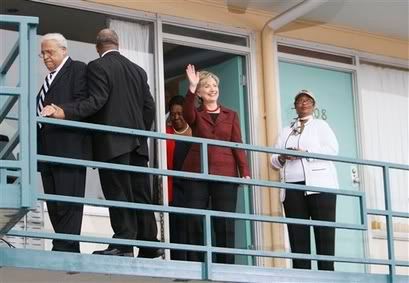
April 4, 1968:

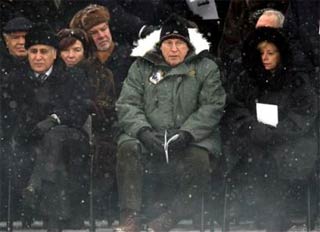 Cheney at Auschwitz, dressed to kill.
April 4, 1968:
The old man on the far left appears to be close to tears. (Why else would the other man be grasping his wrist like that?) And no wonder. He knows where he is, and when.
But where did the possible future President acquire her demeanour? And what did she think she was doing? Attending a St. Paddy's Day parade? Receiving an Oscar? Opening a fucking restaurant?
But where did the possible future President acquire her demeanour? And what did she think she was doing? Attending a St. Paddy's Day parade? Receiving an Oscar? Opening a fucking restaurant?
A nation that continues year after year to spend more money on military defense than on programs of social uplift is approaching spiritual death.
Cheney at Auschwitz, dressed to kill.Sunday, April 06, 2008
Help With Matheory Please
The atmosphere in Belgrade is, at least for the time being, carnivalesque in a faked way - when they are not in shelters, people dance to rock or ethnic music on the streets, under the motto "With music against bombs!", playing the role of the defying heroes (since they know that NATO does not really bomb civilian targets). Although it may fascinate some confused pseudo-Leftists, this obscene carnivalization of the social life is effectively the other, public, face of ethnic cleansing: while in Belgrade people defiantly dance on the streets, three hundred kilometers to the South, a genocide of African proportions is taking place. (Zizek)
Would that be bigger or smaller than European proportions? Is he saying a relatively small genocide, for the European setting, is taking place, or a relatively big one?
Any assistance in clearing this up will be vastly appreciated.
Would that be bigger or smaller than European proportions? Is he saying a relatively small genocide, for the European setting, is taking place, or a relatively big one?
Any assistance in clearing this up will be vastly appreciated.
Saturday, April 05, 2008
Friday, April 04, 2008
No, you're not going to college.
April 4 (Bloomberg) -- The collapse of the $330 billion auction-rate securities market has brought debt sales by U.S. public student-loan agencies to a halt.
No municipal bonds backed by student loans were sold in the first quarter, the first time that happened in almost 40 years, according to Thomson Financial.
[...]
The squeeze means students and parents have fewer options to fund college educations. University financial-aid offices are scrambling to update lists of active lenders and help students find less costly private loan alternatives, said Phillip Day, head of National Association of Student Financial Aid Administrators in Washington ...
When did student loans become a bad investment? Is someone expecting most graduates to be unemployed and insolvent in a few years' time?
No municipal bonds backed by student loans were sold in the first quarter, the first time that happened in almost 40 years, according to Thomson Financial.
[...]
The squeeze means students and parents have fewer options to fund college educations. University financial-aid offices are scrambling to update lists of active lenders and help students find less costly private loan alternatives, said Phillip Day, head of National Association of Student Financial Aid Administrators in Washington ...
When did student loans become a bad investment? Is someone expecting most graduates to be unemployed and insolvent in a few years' time?
Thursday, April 03, 2008

Tuesday, April 01, 2008
Financial Socialism

The Federal Reserve, Washington, D.C. (AP via www.aljazeera.net)
Excellent summary of what's going on in the financial markets here @
Mish's Global Economic Trend Analysis
Monday, March 31, 2008
Saturday, March 29, 2008
Friday, March 28, 2008
Wednesday, March 26, 2008
Monday, March 24, 2008
Saturday, March 22, 2008
Subscribe to:
Posts (Atom)