Some twat at work today: "we've got to bring this up to 2005". His mantra. As if his only moral, intellectual and aesthetic compass is the calender on his desk. I say, no, let's bring it back to 1848. Or somesuch. We've got to escape from 2005 by whatever expedient we can, see it from somewhere else. Not only is the Present not the appropriate measure, it is precisely what stands in need of measurement.
(context: person 'a' wished to present an historical analysis of something (the notion of 'blackness'). So colleague replies 'but what are you doing that I couldn't just download from the internet'. As if history exists pre-constituted as information while the Present is the engine room of all that's exciting and New. Twat craves the New. But as others more knowledgeable than I have said: something is no more valuable because it is new than valuable because it is Near.
Thursday, December 29, 2005

Monday, December 19, 2005
No Child Left Behind
Sharon Shea-Keneally, principal of Mount Anthony Union High School in Bennington, Vermont, was shocked when she received a letter in May from military recruiters demanding a list of all her students, including names, addresses, and phone numbers. The school invites recruiters to participate in career days and job fairs, but like most school districts, it keeps student information strictly confidential. "We don't give out a list of names of our kids to anybody," says Shea-Keneally, "not to colleges, churches, employers -- nobody."
But when Shea-Keneally insisted on an explanation, she was in for an even bigger surprise: The recruiters cited the No Child Left Behind Act, President Bush's sweeping new education law passed earlier this year. There, buried deep within the law's 670 pages, is a provision requiring public secondary schools to provide military recruiters not only with access to facilities, but also with contact information for every student -- or face a cutoff of all federal aid.
"I was very surprised the requirement was attached to an education law," says Shea-Keneally. "I did not see the link."
The military complained this year that up to 15 percent of the nation's high schools are "problem schools" for recruiters. In 1999, the Pentagon says, recruiters were denied access to schools on 19,228 occasions. Rep. David Vitter, a Republican from Louisiana who sponsored the new recruitment requirement, says such schools "demonstrated an anti-military attitude that I thought was offensive."
- David Goodman, in Mother Jones, November/December 2002
Friday, December 16, 2005
Straight-faced


CNN reports, without laughing audibly:
Official: Al-Zarqawi caught, released
Authorities didn't realize prisoner was terrorist mastermind
Thursday, December 15, 2005 Posted: 2244 GMT (0644 HKT)
An Iraqi official says Abu Musab al-Zarqawi was caught and released last year.
BAGHDAD, Iraq (CNN) -- Iraqi security forces caught the most wanted man in the country last year, but released him because they didn't know who he was, the Iraqi deputy minister of interior said Thursday.
Hussain Kamal confirmed that Abu Musab al-Zarqawi -- the al Qaeda in Iraq leader who has a $25 million bounty on his head -- was in custody at some point last year, but he wouldn't provide further details.
A U.S. official couldn't confirm the report, but said he wouldn't dismiss it.
"It is plausible," he said.

"No one ever went broke underestimating the intelligence of the American people."
A post-legal society
NYT:
Bush Secretly Lifted Some Limits on Spying in U.S. After 9/11, Officials Say
By JAMES RISEN
and ERIC LICHTBLAU
Published: December 15, 2005
WASHINGTON, Dec. 15 - Months after the Sept. 11 attacks, President Bush secretly authorized the National Security Agency to eavesdrop on Americans and others inside the United States to search for evidence of terrorist activity without the court-approved warrants ordinarily required for domestic spying, according to government officials.
Under a presidential order signed in 2002, the intelligence agency has monitored the international telephone calls and international e-mail messages of hundreds, perhaps thousands, of people inside the United States without warrants over the past three years in an effort to track possible "dirty numbers" linked to Al Qaeda, the officials said. The agency, they said, still seeks warrants to monitor entirely domestic communications.
The previously undisclosed decision to permit some eavesdropping inside the country without court approval represents a major shift in American intelligence-gathering practices, particularly for the National Security Agency, whose mission is to spy on communications abroad. As a result, some officials familiar with the continuing operation have questioned whether the surveillance has stretched, if not crossed, constitutional limits on legal searches.
"This is really a sea change," said a former senior official who specializes in national security law. "It's almost a mainstay of this country that the N.S.A. only does foreign searches."
Nearly a dozen current and former officials, who were granted anonymity because of the classified nature of the program, discussed it with reporters for The New York Times because of their concerns about the operation's legality and oversight.
According to those officials and others, reservations about aspects of the program have also been expressed by Senator John D. Rockefeller IV, the West Virginia Democrat who is the vice chairman of the Senate Intelligence Committee, and a judge presiding over a secret court that oversees intelligence matters. Some of the questions about the agency's new powers led the administration to temporarily suspend the operation last year and impose more restrictions, the officials said.
Tuesday, December 13, 2005
Eyes Wide Shut: Introducing Sociology

From Eyes Wide Shut: A Critical Reevaluation, by Tim Kreider -
But Eyes Wide Shut is not about "sex." The real pornography in this film is in its lingering, overlit depiction of the shameless, naked wealth of end-of-the-millennium Manhattan, and of the obscene effect of that wealth on the human soul, and on society. National reviewers' myopic focus on sex and the shallow psychologies of the film's central couple, the Harfords, at the expense of every other element in the film—the trappings of stupendous wealth, the references to fin-de-siècle Europe and other imperial periods, the Christmastime setting, or even the sum spent by Dr. Harford in a single illicit night out—suggests more about the blindness of the elites to their own surroundings than it does about Stanley Kubrick's inadequacies as a pornographer. For those with their eyes open, there are plenty of money shots.
There is a moment in Eyes Wide Shut, as Dr. Bill Harford is lying to his wife over the phone from the apartment of a prostitute, when we see a textbook in the foreground called Introducing Sociology. The book's title serves as a sly, mirthless caption to the scene (like the slogan PEACE IS OUR PROFESSION in Dr. Strangelove), showing us prostitution as the basic and defining transaction of our society. It is also, more importantly, a key to reading the film, suggesting that we ought to interpret it sociologically—not, as most reviewers insisted on doing, psychologically.
[...]
[T]his is not a film about the "private dreams and frustrations" of what Ziegler calls "ordinary people"; it is, very pointedly, about really rich people, that notorious one percent of the population that owns forty percent of the wealth.


Thursday, December 08, 2005

Monday, December 05, 2005
The Return of the Repressed
A speech to the Climate March, on 3rd December 2005, by George Monbiot.
I want to take a moment to remind you of where we have come from.
For the first three million years of human history, we lived according to circumstance. Our lives were ruled by the happenstances of ecology. We existed, as all animals do, in fear of hunger, predation, weather and disease.
For the following few thousand years, after we had grasped the rudiments of agriculture and crop storage, we enjoyed greater food security, and soon destroyed most of our non-human predators. But our lives were ruled by the sword, the axe and the spear. The primary struggle was for land. We needed it not just to grow our crops but also to provide our sources of energy – grazing for our horses and bullocks, wood for our fires.
Then we discovered fossil fuels, and everything changed. No longer were we constrained by the need to live on ambient energy; we could support ourselves by means of the sunlight stored over the preceding 350 million years. The new sources of energy permitted the economy to grow – to grow sufficiently to absorb some of the people expelled by the previous era’s land disputes. Fossil fuels allowed both industry and cities to expand, which permitted the workers to organise and to force the despots to loosen their grip on power.
Fossil fuels helped us fight wars of a horror never contemplated before, but they also reduced the need for war. For the first time in human history, indeed for the first time in biological history, there was a surplus of available energy. We could keep body and soul together without having to fight someone else for the energy we needed. Agricultural productivity rose 10 or 20 fold. Economic productivity rose 100 fold. Most of us could live as no one had ever lived before.
And everything you see around you results from that. We have been able to assemble here from all corners of the country because of fossil fuels. We have not been charged and cut down by the yeomanry – or not yet at any rate – because of fossil fuels. Our freedoms, our comforts, our prosperity are all the result of fossil fuels.
Ours are the most fortunate generations that have ever lived. Ours are the most fortunate generations that ever will. We inhabit the brief historical interlude between ecological constraint and ecological catastrophe.
I don’t have to remind you of the two forces which are converging on our lives. We are faced with an impending shortage of the source of energy which is hardest to replace – liquid fossil fuels. And we are faced with the environmental consequences of the fossil fuel burning which has permitted us to be standing here now. The structure, the complexity, the diversity of our lives, everything we know, everything that we have taken for granted, that looked solid and non-negotiable, suddenly looks contingent. All this is a great tottering pile balanced on a ball, a ball that is about to start rolling downhill.
I hear people talking about the carbon cuts they would like to see. I am not interested in what people would like to see. I am interesed in what the science says. And the science is clear. We need not a 20% cut by 2020; not a 60% cut by 2050, but a 90% cut by 2030. Only then do we stand a good chance of keeping carbon concentrations in the atmosphere below 430 parts per million, which means that only then do we stand a good chance of preventing some of the threatened positive feedbacks. If we let it get beyond that point there is nothing we can do. The biosphere takes over as the primary source of carbon. It is out of our hands.
The notion that we can achieve this by replacing fossil fuels with ambient energy is a fantasy. It is true that we have untapped sources of energy in wind, waves, tides and sunlight, but it is neither so concentrated nor so consistent that we can plug it in and carry on as before.
A cut like this requires massive reductions in our energy use. There are some technofixes available, but they are unlikely to take us more than halfway there. If carbon emissions are to be capped at 10%, energy use will have to be capped at under 50%. The only fair means of doing this is national rationing accompanied by global contraction and convergence.
And we find ourselves in an extraordinary position. This is the first mass political movement to demand less, not more. The first to take to the streets in pursuit of austerity. The first to demand that our luxuries, even our comforts, are curtailed.
These are the greatest political challenges any movement has faced. But we are rising to it. We are rising. But let no one tell you it will be easy. If it were just a matter of slagging off George Bush, we would have won by now. But we must struggle not only against him, not only against our own government, not only against each other, but also against ourselves. The struggle against climate change is a struggle against much of what we have become. It is a struggle against some of our most fundamental urges.
We cannot call on others to stop flying if we still fly. We cannot ask the government to force us to change if we are not ready to change. The greatest fight of our lives will be fought not just out there, but also in here.
I want to take a moment to remind you of where we have come from.
For the first three million years of human history, we lived according to circumstance. Our lives were ruled by the happenstances of ecology. We existed, as all animals do, in fear of hunger, predation, weather and disease.
For the following few thousand years, after we had grasped the rudiments of agriculture and crop storage, we enjoyed greater food security, and soon destroyed most of our non-human predators. But our lives were ruled by the sword, the axe and the spear. The primary struggle was for land. We needed it not just to grow our crops but also to provide our sources of energy – grazing for our horses and bullocks, wood for our fires.
Then we discovered fossil fuels, and everything changed. No longer were we constrained by the need to live on ambient energy; we could support ourselves by means of the sunlight stored over the preceding 350 million years. The new sources of energy permitted the economy to grow – to grow sufficiently to absorb some of the people expelled by the previous era’s land disputes. Fossil fuels allowed both industry and cities to expand, which permitted the workers to organise and to force the despots to loosen their grip on power.
Fossil fuels helped us fight wars of a horror never contemplated before, but they also reduced the need for war. For the first time in human history, indeed for the first time in biological history, there was a surplus of available energy. We could keep body and soul together without having to fight someone else for the energy we needed. Agricultural productivity rose 10 or 20 fold. Economic productivity rose 100 fold. Most of us could live as no one had ever lived before.
And everything you see around you results from that. We have been able to assemble here from all corners of the country because of fossil fuels. We have not been charged and cut down by the yeomanry – or not yet at any rate – because of fossil fuels. Our freedoms, our comforts, our prosperity are all the result of fossil fuels.
Ours are the most fortunate generations that have ever lived. Ours are the most fortunate generations that ever will. We inhabit the brief historical interlude between ecological constraint and ecological catastrophe.
I don’t have to remind you of the two forces which are converging on our lives. We are faced with an impending shortage of the source of energy which is hardest to replace – liquid fossil fuels. And we are faced with the environmental consequences of the fossil fuel burning which has permitted us to be standing here now. The structure, the complexity, the diversity of our lives, everything we know, everything that we have taken for granted, that looked solid and non-negotiable, suddenly looks contingent. All this is a great tottering pile balanced on a ball, a ball that is about to start rolling downhill.
I hear people talking about the carbon cuts they would like to see. I am not interested in what people would like to see. I am interesed in what the science says. And the science is clear. We need not a 20% cut by 2020; not a 60% cut by 2050, but a 90% cut by 2030. Only then do we stand a good chance of keeping carbon concentrations in the atmosphere below 430 parts per million, which means that only then do we stand a good chance of preventing some of the threatened positive feedbacks. If we let it get beyond that point there is nothing we can do. The biosphere takes over as the primary source of carbon. It is out of our hands.
The notion that we can achieve this by replacing fossil fuels with ambient energy is a fantasy. It is true that we have untapped sources of energy in wind, waves, tides and sunlight, but it is neither so concentrated nor so consistent that we can plug it in and carry on as before.
A cut like this requires massive reductions in our energy use. There are some technofixes available, but they are unlikely to take us more than halfway there. If carbon emissions are to be capped at 10%, energy use will have to be capped at under 50%. The only fair means of doing this is national rationing accompanied by global contraction and convergence.
And we find ourselves in an extraordinary position. This is the first mass political movement to demand less, not more. The first to take to the streets in pursuit of austerity. The first to demand that our luxuries, even our comforts, are curtailed.
These are the greatest political challenges any movement has faced. But we are rising to it. We are rising. But let no one tell you it will be easy. If it were just a matter of slagging off George Bush, we would have won by now. But we must struggle not only against him, not only against our own government, not only against each other, but also against ourselves. The struggle against climate change is a struggle against much of what we have become. It is a struggle against some of our most fundamental urges.
We cannot call on others to stop flying if we still fly. We cannot ask the government to force us to change if we are not ready to change. The greatest fight of our lives will be fought not just out there, but also in here.
Thursday, December 01, 2005
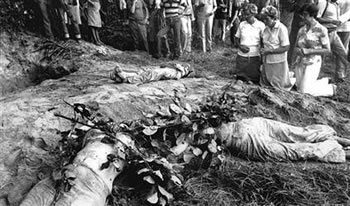
The Salvadoran Option Update
Matthew Rothschild, January 2005:
Democracy Now, Nov 30 2005:
When all the other rationales for this crazy war in Iraq had evaporated, when it had become clear that Saddam didn’t have weapons of mass destruction and Saddam was not working with Osama bin Laden, the Bush Administration seized upon the justification that it was installing democracy in Iraq.
But nothing could be further from installing democracy than installing death squads. And that’s what Rumsfeld is planning over at the Pentagon, according to Newsweek.
It’s called the Salvador option, named after the brutal repression that the U.S. government oversaw in that country in the 1980s, when the CIA financed, trained, and armed death squads that killed and tortured tens of thousands of people.
This should not come as a total surprise, as Cheney and Rumsfeld in the last several months have both held up El Salvador in the 1980s as a model for Iraq today. But it is astonishing to see government officials speaking openly about the desirability of death squads. (Also noteworthy is the confession, in the Newsweek story, that supporting death squads was part of a “still-secret strategy in the Reagan Administration’s battle against the leftist guerilla insurgency.”)
According to Newsweek, “one Pentagon proposal would send Special Forces teams to advise, support, and possibly train Iraqi squads . . . to target Sunni insurgents and their sympathizers, even across the border into Syria.” By going into Syria, the Pentagon would be regionalizing this war—shades of the Cambodia raids during the Vietnam War.
Democracy Now, Nov 30 2005:
ARUN GUPTA: What you're seeing is, I think, really the fruition of U.S. strategy in Iraq. The Pentagon has spent over $10 billion to try to stand up Iraqi military forces, and it's been a complete disaster. So what they're trying to do is they’re turning to death squads to fight the insurgency. The Iraqi forces, the military forces, the army, they really don't stand and fight; and even when they do, they depend on tremendous U.S. logistical support to carry out any operation. So, they really can't operate on their own.
But there are these militias that Donald Rumsfeld was talking about; but, of course, what he doesn’t want to talk about is that the U.S. set up these militias. They funded them. They armed them. They trained them. And a lot of this came out in the Pentagon's own reports, Pentagon’s generals talking about how great they were over a year ago, how they really took the fight to the resistance. And so, what's been going on is that the U.S. has set these up.
And there's been a certain conflict. In April, when the Shiite government took control, they started firing a lot of the commanders who were basically ex-Baathists, and they started bringing in their own guys, especially from the Badr Brigade. And a lot of these are concentrated in what's known as special police commandos, and they have all sorts of various brigades, one called the Wolf Brigade, the Scorpion Brigade, the Lion Brigade, another called the Fearless Warriors. And they sound like death squads. And they are death squads. They go around with masks. They're conducting these raids, especially throughout Baghdad.
And the U.S. is saying, ‘Well, you know, who knows who's doing this?’ But when twenty vehicles pull up with a hundred troops in them, and reporters are recounting -- the New York Times article also recounts this -- they're showing up with sophisticated communications equipment. They're showing up with these expensive Glocks, nine-millimeter Glocks that were supplied by the U.S. government. They have the insignia, the uniforms of the special police commandos. And these -- In Baghdad there's a very strict curfew that’s in place every single night. Yet how can these large convoys of vehicles be going around?
And so, they conduct these roundups, and in many areas it's largely Sunni Arab males. And then they're disappeared. They're taking them to this network of secret prisons. One of the things that’s come out is that there's this absolutely vast network of prisons throughout Iraq. In a nation of 27 million, the Iraqi government has 1,100 prisons.
AMY GOODMAN: Outside the U.S. prisons?
ARUN GUPTA: And this is – Yes, this is in addition to the U.S. prisons. Officially, the Iraqi government says they only have about 12-13,000 detainees. But that really strains credibility. That's only 11 prisoners per facility, whereas the -- what really set this all off was the uncovering of a secret detention center within an interior ministry building where they found approximately 170 men. Another Iraqi male spoke extensively to Reuters where he was kept in a building with 800 men. The BBC just published a report and photographs of another prison that they were allowed to enter, which showed a room so crowded that the prisoners could barely sit down. So nobody knows even really how many prisoners are being held by the Iraqi government.
And what's been happening is that they're being -- you're finding all these men being seized, primarily it looks like Sunni Arab males who are though to form the core of the armed resistance, and then bodies are turning up weeks, months later, often two or three governances away. So they’re seized in Baghdad, for instance, and then these 20-30 bodies will turn up on the Iranian border. And that part of the area is completely controlled by Shiite militias. The Sunni resistance has very little presence down there.
JUAN GONZALEZ: Now, when you mentioned these death squads, you mentioned the Badr Brigades. Now, Moqtada al-Sadr has been an opponent of the U.S. occupation --
ARUN GUPTA: Yes.
JUAN GONZALEZ: And he’s been hunted at several times by U.S. forces. Are you saying that there’s at the same time ongoing cooperation by some of his people with --?
ARUN GUPTA: Well, the Badr Brigade is linked to the Supreme Council for Islamic Revolution in Iraq which is based in -- which was based in Iran. Al-Sadr's forces are distinct: the Mahdi Army. And in the words of one high-ranking U.S. official who spoke to the L.A. Times, he said that the Badr Brigade has special commandos and the Mahdi Army has the police at Baghdad. And he said, quote: “Everybody's got their own death squads.” Now, this is a high-ranking U.S. military official, and this is admitted by also Iraqi officials.
AMY GOODMAN: We only have a minute to go, Arun. But the issue of U.S. military advisors to these death squads?
ARUN GUPTA: Yes. There are two advisors, in particular. One is named Steve Castillo. He was a high-ranking intelligence officer with the Drug Enforcement Agency throughout Latin America, and he was actually in charge of the interior ministry until the handover of sovereignty on June 20, 2004. And the other is Jim Steele who was in charge of Special Forces, a team of 55 Special Forces in El Salvador during that brutal counter-insurgency war, where they trained El Salvadoran forces and oversaw a very brutal counterinsurgency war, where tens of thousands were killed by death squads. And both of these are operating in the interior ministry. So the idea that this is going on without U.S. knowledge, it's really -- it's just -- it's plausible deniability is what they’re trying to do.
Wednesday, November 30, 2005
What Next
Seymour Hersh:
AMY GOODMAN: Seymour Hersh joins us now from his home in Washington, D.C. His piece in The New Yorker magazine is entitled "Up in the Air: Where is the Iraq War Headed Next?" Welcome to Democracy Now!
SEYMOUR HERSH: Hi.
AMY GOODMAN: It’s good to have you with us. So, can you just lay out what you understand at this point and who your sources are telling you what the administration's plans are, or hopes are, next?
SEYMOUR HERSH: I’m not going to hold you literally to who your sources are. But obviously, for the last four years, I've been talking to people pretty much on the inside, or at least have a good smell of what's going on. And, as you said, it's real simple. We are -- I think the President will probably agree to a pullout. He could not, because he is totally committed to what he's doing. But for political purposes, a pullout won't end the war. That's the critical thing.
It won't bring victory to us. It will simply change the color, if you will, of the people who die there. Instead of American boys dying -- certainly change the nationality -- there will be more Iraqis. It doesn't mean victory. It just -- we're going to -- the Iraqi units, most of them, very few can stand up by themselves. But there's the belief in the military is that an Iraqi battalion that’s hapless as it may be now, supported by more American air, any time they have a whiff of the insurgency, they can call in an air strike, that would give them enough wherewithal to withstand, at least stand up, for a couple of years, long enough to mask a complete withdrawal.
AMY GOODMAN: Why hasn't the Bush administration done this yet?
SEYMOUR HERSH: Well, they are doing more bombing. One of the great x-factors of the war -- this is something else that I noted in the article, is we know nothing about the bombing. Clearly there's all sorts of anecdotal reason to believe that the bombing has gone up exponentially, certainly in the last four or five months in the Sunni Triangle, the four provinces around Baghdad. There's been a lot of -- more provinces. Every day, we read about bombs falling. And we now have planes that loiter, hornets, and we have planes that come from a base in Kirkuk, I think, and they loiter in the air above potential combat areas. You know, there go three guys, throw a bomb there.
And there's no statistics. I’m one of those people that goes back to the Vietnam War, where every day we got a description and an official account of how many sorties, one mission by one plane, how much tonnage. We don't get any of those numbers in this war. We’ve never had those numbers. There's no embedded American journalist at an airbase – at one of the bases in the Gulf region. I think many of the air bases right now -- some of our air bases are obviously inside Iraq. But that's pretty much, I presume, to be a classified secret, or a secret, anyway. We don't have reporters at the air bases. We don't know what's going on with the air war.
AMY GOODMAN: We're talking to Seymour Hersh, wrote a piece in this week's New Yorker, called "Up in the Air: Where is the Iraq War Headed Next?" Sy, can you talk about John Murtha, the congressman, and the significance of what he said?
SEYMOUR HERSH: Murtha is one of those oldies, in his 70s now. He’s somebody like me, I always try to get to. I can talk to some of his aides. He's on the Defense -- he’s one of the leading players on the Defense Appropriations Subcommittee. He's a very conservative military guy, who controls the budget, not only the budget we know about, but the black budget, the covert budget. He's one of those people trusted. Jerry Lewis in the Congress is another one, a House member. In the Senate, it would be Senator Inouye of Hawaii and Senator Ted Stevens, both in their 80s, of Alaska. They run the Senate Defense Appropriations Subcommittee. These are the guys that the generals talk to. And Murtha is one, in particular. He’s known for his closeness to the four-stars. They come and they bleed on him.
And so, for Murtha to suddenly say it's over, as he did three weeks ago or two weeks ago, as I wrote in this article, it drove the White House crazy. They were beyond mad, as somebody said to me, because they know that the generals are talking to him. So here you have a case where we don't have -- you know, the generals are terrified pretty much, as they always are. That's just the nature of the game. But they don't speak truth to power. They're not telling the American people exactly what's going on, and they're clearly not telling the White House, because the White House doesn't want to hear.
So Murtha's message is a message, really, from a -- you can consider it a message from a lot of generals on active duty today. This is what they think, at least a significant percentage of them, I assure you. This is, I’m not over-dramatizing this. It's a shot across the bow. They don't think it's doable. You can't tell that to this President. He doesn't want to hear it. But you can say it to Murtha, you can say it to Inouye, you can say it to Stevens.
AMY GOODMAN: It's interesting what you write, the examples of what Murtha said, the most devastating comments that he reported. “The number of attacks in Iraq has increased from a hundred and fifty a week to more than seven hundred a week in the past year. He said that an estimated fifty thousand American soldiers will suffer ‘from what I call battle fatigue’ in the war, and he said that the Americans were seen as ‘the common enemy’ in Iraq. He also took issue with one of the White House's claims -- that foreign fighters are playing a major role in the insurgency.” In fact, he says, “American soldiers ‘haven't captured any in this latest activity’ -- the continuing battle in western Anbar province, near the border with Syria. ‘So this idea that they're coming in from outside, we still think there's only seven per cent,’” Murtha said.
SEYMOUR HERSH: And most of those, you know, the Sunnis and Baathists have no love for jihadists. I mean, Saddam was always on war against jihadists, just as Asad was, the father of the son back in Syria. There's no love among the secular Baathists for any fundamentalism. And so what happens is it's very cynical. What's happened now is the insurgency welcomes -- if you want to come and be a car bomber, come on in and kill yourself. They couldn't care less. But it's not as if there's any shared responsibility there.
This is a war run by the Baathists and the Sunnis and many Iraqi citizens, who initially had no reason to dislike us, but because of the way we've behaved in the war and the way we've conducted the war with these house-to-house searches and the search-and-destroy missions and the bombing. You know, bombs don't -- they never always go where they’re aimed, even though they’re more accurate than ever, they’re still --even the Pentagon statistics indicate 10-15% of bombs don't go where they're aimed, even with laser guidance.
So, Murtha, yes, I was interested in the press coverage, because they did deal with what he said about Cheney and his caustic comment. But in the speech was this -- I thought the statistic that was devastating was the 50,000 statistic, of combat fatigue or whatever syndrome they call it now, more sophisticated than that word now. But my friends inside the V.A. tell me that as of late June or early July, there had been about, oh, 900-950,000 American soldiers, men and women that have gone to war since March or April of ’03, by July of ’05, two years and three or four months later, over 104,000 had come into the V.A. looking for help. Once they returned, rotated home, come back to V.A. hospitals, a staggering statistic. You know, you can’t -- we talk about torture. And one of the things to remember about mistreating people is, you know -- this isn't cynical, but I really do mean it -- you know, the people that do the mistreatment end up being as much victims as the people they mistreat. They come home with a lot of lot of bad baggage.
AMY GOODMAN: We're talking to Seymour Hersh, Pulitzer Prize-winning journalist for The New Yorker, also helped to expose the torture at Abu Ghraib in April of 2004. The issue of the generals not speaking out, how unusual is this? I mean, would anyone expect it in any administration?
SEYMOUR HERSH: No, you know, really that's – you know, that's what we're here for. We have a congress that on any given day, you know, as I always joke, is -- I can't tell whether they're supine or prone, but they're down. You've got a dead congress that can barely move. I mean, the fear, you know, the thunderous noise of the Democrats running away from Murtha. Murtha makes this statement, and all that the Democrats do is left in the party, couldn't run away fast enough from this man. He was left alone there. Even Nancy Pelosi, nobody supported him when he called for an immediate withdrawal.
AMY GOODMAN: I mean, this is actually astounding. And then the Republicans coming forward and saying, ‘Okay, we're going to put foward this proposal,’ and it's – what? – 403 to 3. Jose Serrano, Cynthia McKinney. Now, what was wrong with the proposal, just saying withdraw immediately?
SEYMOUR HERSH: Well, actually, what he was saying, six months. And I would guess that if you really pushed him hard, his argument would be that once we withdraw, if -- I think every week it gets harder and harder to do this -- once you withdraw, the first thing the insurgency, the Sunnis and Baathists, would do would be to turn on the jihadists -- there's no love between them -- you know, and immediately push them out of the picture and then begin to try and get some political stake and begin to talk with the other people, the Shia and the secular, you know, Iraq. Even Shia Iraq, more Shia are secular than religious. Most people don’t know that. There's many tremendous divisions inside Iraq among the Shia.
And so, a year ago, it seemed to me, the -- a year ago -- Amy, it's so crazy, because we always repeat history. In 1965, if anybody in the Democratic Party -- Bobby Kennedy once tried to tentatively suggest that the way out of the Vietnam War was talk to the North Vietnamese. You would have been laughed out of the ballpark. We don't talk to the guys we're fighting the war with. And so, clearly the way out was to talk to the Sunni and Baathist leadership. Clearly, they're organized fairly well. Obviously this insurgency is extremely well done. They've gotten, if anything, more sophisticated.
If you remember, this summer, General Casey, alas, said that the Iraqi -- the insurgency is defeated now; they're only hitting soft targets, that is, civilians. And the next thing you know, we have a hundred deaths of American soldiers in a month. I mean, that's clearly not true. They clearly can do what they want. My own guess is, and I’m told this by my friends on the inside, there's tremendous intelligence. And the Israelis, among other people, are warning us that this wonderful Green Zone that we think is such an oasis could be hit any time. They're clearly able to penetrate into that. And so, it's all up for grabs. Why not talk to them? Now, it's probably too late. I don't know what we can do to salvage the situation.
AMY GOODMAN: Seymour Hersh, you also write about President Bush and how his closest advisors have long been aware of the religious nature of his policy commitments. In recent interviews, one former senior official who served in Bush's first term spoke extensively about the connection between the President's religious faith and his view of the war in Iraq. Can you elaborate on this?
SEYMOUR HERSH: Well, it's interesting about this particular person and others with whom -- all of a sudden -- it's weird, but in the last -- people that I've been talking to for years never discuss this. All of a sudden, within the last month or so, somebody, just in the middle of a conversation about somebody else, began to talk about how the President viewed 9/11 as a challenge and sort of as a divine challenge, and the election in 2002 he saw as a sign from God, a reaffirmation. If you remember, the Republicans did very well in the off-year congressional election. And then, of course, in 2004, this president ran, didn't give one inch up on the Iraqi war, did not back off an inch and won, another sign of guidance. And so this person was saying -- I don't know whether it's true or not, but it's certainly what this person saw and heard, but I don't know what's in the President's mind. He's also committed to democracy.
But what's happening now is, I think, because he's so unreachable by common -- I think one reason the generals went to Murtha is you can't tell this to the President. I think people -- I don't want to use – I’ll just use the word, I think they're scared to death. I think some of the insiders are really scared to death that you have a president that's presiding over -- it's -- the exit plan for this war is totally dependant on the Iraqi military, which is comical. It's driven by militias. I don't know, many in your audience have probably read the wonderful Jim Fallows article in the Atlantic, which I thought was quite explicit about how bad it is. And also, nobody even mentions the Iraqi police. They're completely destroyed and useless and demoralized. So the idea that withdrawal is going to be dependant on the Iraqi police and the military is a fantasy.
And so, what are we -- we're going to leave and increase the bombing and the Iraqis eventually -- this is what's driving the Air Force crazy is I wrote about the Iraqis will be responsible for targeting? You know, who's going to hit what? I've actually had senior intelligence people say to me that means Iran will be targeting our bombers. I mean, it’s just loony. It's a loony formula.
AMY GOODMAN: Last question, and that has to do with your last section of your piece on this composite American Special Forces team, known as the S.M.U., special mission unit, in Syria.
SEYMOUR HERSH: Well, there's more than one. There's many of them. You know, there's more than a handful of these units. Some are in Syria, some are other places. These are combined teams that have been set up, so not any one service isn’t involved. And I think, you know, obviously we think that this government believes that when it comes to a high-value target, you know, a potential al-Qaeda or believed al-Qaeda target, we can do anything we want anywhere in the world. And the world's our playpen. And I can tell you right now, inside the American intelligence community, and I’m talking about high up in the community, there's a great deal of concern about these kind of operations, because our troop go in and do what they do to people they think are Iraqis -- I mean, al-Qaeda. And it's very rough. And they don't clear it with either the State Department or the ambassador in the country or the C.I.A. chief of station. It's a formula for chaos. And it's going on now. And it's been going on for quite a while, many months. And it's a new sort of step-up in the war. And Congress? Do they want to know? I don't think so.
AMY GOODMAN: And the S.M.U.s, where else are they? The special mission units?
SEYMOUR HERSH: In places where we think there's – you know, certainly in Iraq, and other places in the world where we think they can do some good.
AMY GOODMAN: By the way, do you believe that the secret prisons are in Romania and Poland, as Human Rights Watch believes, that the Washington Post won't name, but exposed?
SEYMOUR HERSH: Well, Amy, I’m actually doing some more work on it. But I will tell you this, the C.I.A. prisons are there. There have been prisons, the C.I.A. has run prisons for many, many years around the world. And I’m sure terrible things happen. But that's actually not where the real game is. They're somewhere else.
AMY GOODMAN: Where?
SEYMOUR HERSH: Other places. I’m -- let me do my reporting, and I promise I’ll publish it, and I promise I’ll come and talk to you about it.
AMY GOODMAN: Okay, well, Seymour Hersh, I want to thank you for being with us. His latest piece is in The New Yorker magazine; it is called "Up in the Air: Where is the Iraq War Headed Next?" Seymour Hersh, Pulitzer Prize-winning journalist, thanks for being with us.
AMY GOODMAN: Seymour Hersh joins us now from his home in Washington, D.C. His piece in The New Yorker magazine is entitled "Up in the Air: Where is the Iraq War Headed Next?" Welcome to Democracy Now!
SEYMOUR HERSH: Hi.
AMY GOODMAN: It’s good to have you with us. So, can you just lay out what you understand at this point and who your sources are telling you what the administration's plans are, or hopes are, next?
SEYMOUR HERSH: I’m not going to hold you literally to who your sources are. But obviously, for the last four years, I've been talking to people pretty much on the inside, or at least have a good smell of what's going on. And, as you said, it's real simple. We are -- I think the President will probably agree to a pullout. He could not, because he is totally committed to what he's doing. But for political purposes, a pullout won't end the war. That's the critical thing.
It won't bring victory to us. It will simply change the color, if you will, of the people who die there. Instead of American boys dying -- certainly change the nationality -- there will be more Iraqis. It doesn't mean victory. It just -- we're going to -- the Iraqi units, most of them, very few can stand up by themselves. But there's the belief in the military is that an Iraqi battalion that’s hapless as it may be now, supported by more American air, any time they have a whiff of the insurgency, they can call in an air strike, that would give them enough wherewithal to withstand, at least stand up, for a couple of years, long enough to mask a complete withdrawal.
AMY GOODMAN: Why hasn't the Bush administration done this yet?
SEYMOUR HERSH: Well, they are doing more bombing. One of the great x-factors of the war -- this is something else that I noted in the article, is we know nothing about the bombing. Clearly there's all sorts of anecdotal reason to believe that the bombing has gone up exponentially, certainly in the last four or five months in the Sunni Triangle, the four provinces around Baghdad. There's been a lot of -- more provinces. Every day, we read about bombs falling. And we now have planes that loiter, hornets, and we have planes that come from a base in Kirkuk, I think, and they loiter in the air above potential combat areas. You know, there go three guys, throw a bomb there.
And there's no statistics. I’m one of those people that goes back to the Vietnam War, where every day we got a description and an official account of how many sorties, one mission by one plane, how much tonnage. We don't get any of those numbers in this war. We’ve never had those numbers. There's no embedded American journalist at an airbase – at one of the bases in the Gulf region. I think many of the air bases right now -- some of our air bases are obviously inside Iraq. But that's pretty much, I presume, to be a classified secret, or a secret, anyway. We don't have reporters at the air bases. We don't know what's going on with the air war.
AMY GOODMAN: We're talking to Seymour Hersh, wrote a piece in this week's New Yorker, called "Up in the Air: Where is the Iraq War Headed Next?" Sy, can you talk about John Murtha, the congressman, and the significance of what he said?
SEYMOUR HERSH: Murtha is one of those oldies, in his 70s now. He’s somebody like me, I always try to get to. I can talk to some of his aides. He's on the Defense -- he’s one of the leading players on the Defense Appropriations Subcommittee. He's a very conservative military guy, who controls the budget, not only the budget we know about, but the black budget, the covert budget. He's one of those people trusted. Jerry Lewis in the Congress is another one, a House member. In the Senate, it would be Senator Inouye of Hawaii and Senator Ted Stevens, both in their 80s, of Alaska. They run the Senate Defense Appropriations Subcommittee. These are the guys that the generals talk to. And Murtha is one, in particular. He’s known for his closeness to the four-stars. They come and they bleed on him.
And so, for Murtha to suddenly say it's over, as he did three weeks ago or two weeks ago, as I wrote in this article, it drove the White House crazy. They were beyond mad, as somebody said to me, because they know that the generals are talking to him. So here you have a case where we don't have -- you know, the generals are terrified pretty much, as they always are. That's just the nature of the game. But they don't speak truth to power. They're not telling the American people exactly what's going on, and they're clearly not telling the White House, because the White House doesn't want to hear.
So Murtha's message is a message, really, from a -- you can consider it a message from a lot of generals on active duty today. This is what they think, at least a significant percentage of them, I assure you. This is, I’m not over-dramatizing this. It's a shot across the bow. They don't think it's doable. You can't tell that to this President. He doesn't want to hear it. But you can say it to Murtha, you can say it to Inouye, you can say it to Stevens.
AMY GOODMAN: It's interesting what you write, the examples of what Murtha said, the most devastating comments that he reported. “The number of attacks in Iraq has increased from a hundred and fifty a week to more than seven hundred a week in the past year. He said that an estimated fifty thousand American soldiers will suffer ‘from what I call battle fatigue’ in the war, and he said that the Americans were seen as ‘the common enemy’ in Iraq. He also took issue with one of the White House's claims -- that foreign fighters are playing a major role in the insurgency.” In fact, he says, “American soldiers ‘haven't captured any in this latest activity’ -- the continuing battle in western Anbar province, near the border with Syria. ‘So this idea that they're coming in from outside, we still think there's only seven per cent,’” Murtha said.
SEYMOUR HERSH: And most of those, you know, the Sunnis and Baathists have no love for jihadists. I mean, Saddam was always on war against jihadists, just as Asad was, the father of the son back in Syria. There's no love among the secular Baathists for any fundamentalism. And so what happens is it's very cynical. What's happened now is the insurgency welcomes -- if you want to come and be a car bomber, come on in and kill yourself. They couldn't care less. But it's not as if there's any shared responsibility there.
This is a war run by the Baathists and the Sunnis and many Iraqi citizens, who initially had no reason to dislike us, but because of the way we've behaved in the war and the way we've conducted the war with these house-to-house searches and the search-and-destroy missions and the bombing. You know, bombs don't -- they never always go where they’re aimed, even though they’re more accurate than ever, they’re still --even the Pentagon statistics indicate 10-15% of bombs don't go where they're aimed, even with laser guidance.
So, Murtha, yes, I was interested in the press coverage, because they did deal with what he said about Cheney and his caustic comment. But in the speech was this -- I thought the statistic that was devastating was the 50,000 statistic, of combat fatigue or whatever syndrome they call it now, more sophisticated than that word now. But my friends inside the V.A. tell me that as of late June or early July, there had been about, oh, 900-950,000 American soldiers, men and women that have gone to war since March or April of ’03, by July of ’05, two years and three or four months later, over 104,000 had come into the V.A. looking for help. Once they returned, rotated home, come back to V.A. hospitals, a staggering statistic. You know, you can’t -- we talk about torture. And one of the things to remember about mistreating people is, you know -- this isn't cynical, but I really do mean it -- you know, the people that do the mistreatment end up being as much victims as the people they mistreat. They come home with a lot of lot of bad baggage.
AMY GOODMAN: We're talking to Seymour Hersh, Pulitzer Prize-winning journalist for The New Yorker, also helped to expose the torture at Abu Ghraib in April of 2004. The issue of the generals not speaking out, how unusual is this? I mean, would anyone expect it in any administration?
SEYMOUR HERSH: No, you know, really that's – you know, that's what we're here for. We have a congress that on any given day, you know, as I always joke, is -- I can't tell whether they're supine or prone, but they're down. You've got a dead congress that can barely move. I mean, the fear, you know, the thunderous noise of the Democrats running away from Murtha. Murtha makes this statement, and all that the Democrats do is left in the party, couldn't run away fast enough from this man. He was left alone there. Even Nancy Pelosi, nobody supported him when he called for an immediate withdrawal.
AMY GOODMAN: I mean, this is actually astounding. And then the Republicans coming forward and saying, ‘Okay, we're going to put foward this proposal,’ and it's – what? – 403 to 3. Jose Serrano, Cynthia McKinney. Now, what was wrong with the proposal, just saying withdraw immediately?
SEYMOUR HERSH: Well, actually, what he was saying, six months. And I would guess that if you really pushed him hard, his argument would be that once we withdraw, if -- I think every week it gets harder and harder to do this -- once you withdraw, the first thing the insurgency, the Sunnis and Baathists, would do would be to turn on the jihadists -- there's no love between them -- you know, and immediately push them out of the picture and then begin to try and get some political stake and begin to talk with the other people, the Shia and the secular, you know, Iraq. Even Shia Iraq, more Shia are secular than religious. Most people don’t know that. There's many tremendous divisions inside Iraq among the Shia.
And so, a year ago, it seemed to me, the -- a year ago -- Amy, it's so crazy, because we always repeat history. In 1965, if anybody in the Democratic Party -- Bobby Kennedy once tried to tentatively suggest that the way out of the Vietnam War was talk to the North Vietnamese. You would have been laughed out of the ballpark. We don't talk to the guys we're fighting the war with. And so, clearly the way out was to talk to the Sunni and Baathist leadership. Clearly, they're organized fairly well. Obviously this insurgency is extremely well done. They've gotten, if anything, more sophisticated.
If you remember, this summer, General Casey, alas, said that the Iraqi -- the insurgency is defeated now; they're only hitting soft targets, that is, civilians. And the next thing you know, we have a hundred deaths of American soldiers in a month. I mean, that's clearly not true. They clearly can do what they want. My own guess is, and I’m told this by my friends on the inside, there's tremendous intelligence. And the Israelis, among other people, are warning us that this wonderful Green Zone that we think is such an oasis could be hit any time. They're clearly able to penetrate into that. And so, it's all up for grabs. Why not talk to them? Now, it's probably too late. I don't know what we can do to salvage the situation.
AMY GOODMAN: Seymour Hersh, you also write about President Bush and how his closest advisors have long been aware of the religious nature of his policy commitments. In recent interviews, one former senior official who served in Bush's first term spoke extensively about the connection between the President's religious faith and his view of the war in Iraq. Can you elaborate on this?
SEYMOUR HERSH: Well, it's interesting about this particular person and others with whom -- all of a sudden -- it's weird, but in the last -- people that I've been talking to for years never discuss this. All of a sudden, within the last month or so, somebody, just in the middle of a conversation about somebody else, began to talk about how the President viewed 9/11 as a challenge and sort of as a divine challenge, and the election in 2002 he saw as a sign from God, a reaffirmation. If you remember, the Republicans did very well in the off-year congressional election. And then, of course, in 2004, this president ran, didn't give one inch up on the Iraqi war, did not back off an inch and won, another sign of guidance. And so this person was saying -- I don't know whether it's true or not, but it's certainly what this person saw and heard, but I don't know what's in the President's mind. He's also committed to democracy.
But what's happening now is, I think, because he's so unreachable by common -- I think one reason the generals went to Murtha is you can't tell this to the President. I think people -- I don't want to use – I’ll just use the word, I think they're scared to death. I think some of the insiders are really scared to death that you have a president that's presiding over -- it's -- the exit plan for this war is totally dependant on the Iraqi military, which is comical. It's driven by militias. I don't know, many in your audience have probably read the wonderful Jim Fallows article in the Atlantic, which I thought was quite explicit about how bad it is. And also, nobody even mentions the Iraqi police. They're completely destroyed and useless and demoralized. So the idea that withdrawal is going to be dependant on the Iraqi police and the military is a fantasy.
And so, what are we -- we're going to leave and increase the bombing and the Iraqis eventually -- this is what's driving the Air Force crazy is I wrote about the Iraqis will be responsible for targeting? You know, who's going to hit what? I've actually had senior intelligence people say to me that means Iran will be targeting our bombers. I mean, it’s just loony. It's a loony formula.
AMY GOODMAN: Last question, and that has to do with your last section of your piece on this composite American Special Forces team, known as the S.M.U., special mission unit, in Syria.
SEYMOUR HERSH: Well, there's more than one. There's many of them. You know, there's more than a handful of these units. Some are in Syria, some are other places. These are combined teams that have been set up, so not any one service isn’t involved. And I think, you know, obviously we think that this government believes that when it comes to a high-value target, you know, a potential al-Qaeda or believed al-Qaeda target, we can do anything we want anywhere in the world. And the world's our playpen. And I can tell you right now, inside the American intelligence community, and I’m talking about high up in the community, there's a great deal of concern about these kind of operations, because our troop go in and do what they do to people they think are Iraqis -- I mean, al-Qaeda. And it's very rough. And they don't clear it with either the State Department or the ambassador in the country or the C.I.A. chief of station. It's a formula for chaos. And it's going on now. And it's been going on for quite a while, many months. And it's a new sort of step-up in the war. And Congress? Do they want to know? I don't think so.
AMY GOODMAN: And the S.M.U.s, where else are they? The special mission units?
SEYMOUR HERSH: In places where we think there's – you know, certainly in Iraq, and other places in the world where we think they can do some good.
AMY GOODMAN: By the way, do you believe that the secret prisons are in Romania and Poland, as Human Rights Watch believes, that the Washington Post won't name, but exposed?
SEYMOUR HERSH: Well, Amy, I’m actually doing some more work on it. But I will tell you this, the C.I.A. prisons are there. There have been prisons, the C.I.A. has run prisons for many, many years around the world. And I’m sure terrible things happen. But that's actually not where the real game is. They're somewhere else.
AMY GOODMAN: Where?
SEYMOUR HERSH: Other places. I’m -- let me do my reporting, and I promise I’ll publish it, and I promise I’ll come and talk to you about it.
AMY GOODMAN: Okay, well, Seymour Hersh, I want to thank you for being with us. His latest piece is in The New Yorker magazine; it is called "Up in the Air: Where is the Iraq War Headed Next?" Seymour Hersh, Pulitzer Prize-winning journalist, thanks for being with us.
Tuesday, November 29, 2005
"But honestly, I mean, conspiracy theories…"
Looking tired, [Tony Blair] appeared to lose his cool when asked about reports claiming that the memo showed him talking Mr Bush out of mounting an air raid on al-Jazeera. "Look, there's a limit to what I can say - it's all sub judice," he said. "But honestly, I mean, conspiracy theories…"

Conspiracy theory (n. pej.): Any accusation of serious government wrongdoing that has not yet been proven in a court of law.
Conspiracy theorist (n. pej.): In ruling-class parlance, anyone who suspects that the government has been guilty of serious wrongdoing. A reliable thought-stopper, the term "conspiracy theorist" serves to distract attention from facts inconvenient to the government by casting doubt on the sanity of anyone conversant with those facts.
Conspiracy theory (n. pej.): Any accusation of serious government wrongdoing that has not yet been proven in a court of law.
Conspiracy theorist (n. pej.): In ruling-class parlance, anyone who suspects that the government has been guilty of serious wrongdoing. A reliable thought-stopper, the term "conspiracy theorist" serves to distract attention from facts inconvenient to the government by casting doubt on the sanity of anyone conversant with those facts.
Thursday, November 24, 2005
Kidnapped Home
A taxi driver in Vienna said to the passenger he picked up at the airport, "Have you heard these new radio ads the Polish tourist board is running here? Come to Warsaw! Your car is already here."
Let's go to Socialism. Everything is already there.
-Marx, Grundrisse, The Chapter On Money
Let's go to Socialism. Everything is already there.
(...In the case of the world market, the connection of the individual with all, but at the same time the independence of the conection from the individual, have developed to such a high level that the formation of the world market already at the same time contains the conditions for going beyond it.) Comparison in place of real communality and generality.
(It has been said and may be said that this is precisely the beauty and the greatness of it: this spontaneous interconnection, this material and mental metabolism which is independent of the knowing and willing of individuals, and which presupposes their reciprocal independence and indifference. And, certainly, this objective connection is preferable to the lack of any connection, or to a merely local connection resting on blood ties, or on primeval, natural or master-servant relations. Equally certain is it that individuals cannot gain mastery over their own social interconnections before they have created them. But it is an insipid notion to conceive of this merely objective bond as a spontaneous, natural attribute inherent in individuals and inseperable from their nature (in antithesis to their conscious knowing and willing). This bond is their product. It is an historic product. It belongs to a specific phase of their development. The alien and independent character in which it presently exists vis-à-vis individuals proves only that the latter are still engaged in the creation of the conditions of their social life, and that they have not yet begun, on the basis of these conditions, to live it. It is the bond natural to individuals within specific and limited relations of production. Universally developed individuals, whose social relations, as their own communal [gemeinschaftlich] relations, are hence also subordinated to their own communal control, are no product of nature, but of history. The degree and the unversality of the development of wealth where this individuality becomes possible supposes production on the basis of exchange values as a prior condition, whose universality produces not only the alienation of the individual from himself and from others, but also the universality and the comprehensiveness of his relations and capacities. In earlier stages of development the single individual seems to be developed more fully, because he has not yet worked out his relationships in their fullness, or erected them as independent social powers and relations opposite himself. It is as ridiculous to yearn for a return to that original fullness as it is to believe that with this complete emptiness history has come to a standstill. The bourgeois viewpoint has never advanced beyond this antithesis between itself and this romantic viewpoint, and therefore the latter will accompany it as legitimate antithesis up to its blessed end.)
(The relation of the individual to science may be taken as an example here.)
-Marx, Grundrisse, The Chapter On Money
Tuesday, November 22, 2005
"When we act, we create our own reality"
Via Springheel Jack:

LONDON (AP) - A British civil servant has been charged under the Official Secrets Act for allegedly leaking a government memo that, according to a newspaper report Tuesday, suggests that Prime Minister Tony Blair persuaded President George W. Bush not to bomb the Arab satellite station Al-Jazeera.
According to the Daily Mirror, Bush spoke of targeting Al-Jazeera's headquarters in Doha, Qatar, when he met Blair at the White House on April 16 last year. The U.S. government has regularly accused Al-Jazeera of being a mouthpiece for anti-American sentiments.
[...]
Critics jumped on the report, saying it raised questions about U.S. military attacks on Al-Jazeera offices in Afghanistan and Iraq that Washington said were accidental, as well as on other reportedly accidental U.S. attacks on journalists in Iraq.
In April 2003, an Al-Jazeera journalist died when its Baghdad office was struck during a U.S. bombing campaign. Nabil Khoury, a U.S. State Department spokesman in Doha, said the strike was a mistake.
In November 2002, Al-Jazeera's office in Kabul, Afghanistan, was destroyed by a U.S. missile. None of the staff was at the office at the time. U.S. officials said they believed the target was a terrorist site and did not know it was Al-Jazeera's office.
—CNEWS
Monday, November 21, 2005
Cracks in the mirror

A journalist in Pittsburgh establishes his credentials by making the usual nervous jokes about "conspiracy theories", but proceeds to give an unusually fair summary of the paper he links to:
"You can drive yourself nuts with conspiracy theories. Many of our fellow Americans already have. Just go to the nearest PC and start googling. [...] Who knows what really happened? How can a good citizen ever find out the truth or anything close to it? Even with the wonders of the Internet, it's somewhere between hopeless and impossible.
Look what happens when you read the academic paper questioning the official version of the collapse of the three World Trade Center buildings that Brigham Young University physics professor Steven E. Jones recently posted at
physics.byu.edu/research/energy/htm7.html."
Professor Jones really did his science homework. He supplies links to slow-motion video of collapsing buildings, discusses their well-engineered innards at length and doggedly critiques the official explanation. Jones isn't the first to make this shocking/unbelievable claim (see wtc7.net). But it's hard to imagine anyone making it clearer."
[NOTE: Post edited to remove the unnecessarily snarky commentary. This is a positively heroic effort by comparison with most of what appears in the corporate media.]
Tackling Underdevelopment
 Photo: Sebastiao Salgado
When [Jeffrey Sachs] launched his book The End of Poverty, people everywhere took notice. Time magazine even made it into a cover story. But there is a problem with Sachs’ how-to-end poverty prescriptions. He simply doesn’t understand where poverty comes from. He seems to view it as the original sin. “A few generations ago, almost everybody was poor,” he writes, then adding: “The Industrial Revolution led to new riches, but much of the world was left far behind.” This is a totally false history of poverty. The poor are not those who have been “left behind”; they are the ones who have been robbed.
[...] When society’s relationship with nature is based on sustenance, nature exists as a form of common wealth. It is redefined as a “resource” only when profit becomes the organising principle of society and sets off a financial imperative for the development and destruction of these resources for the market. However much we choose to forget or deny it, all people in all societies still depend on nature. Without clean water, fertile soils and genetic diversity, human survival is not possible. Today, economic development is destroying these onetime commons, resulting in the creation of a new contradiction: development deprives the very people it professes to help of their traditional land and means of sustenance, forcing them to survive in an increasingly eroded natural world. A system like the economic growth model we know today creates trillions of dollars of super profits for corporations while condemning billions of people to poverty. Poverty is not, as Sachs suggests, an initial state of human progress from which to escape. It is a final state people fall into when one-sided development destroys the ecological and social systems that have maintained the life, health and sustenance of people and the planet for ages. The reality is that people do not die for lack of income. They die for lack of access to the wealth of the commons.
-- Vandana Shiva: Two myths that keep the world poorThis is the 'problem,' and the grand fantasy, springing to the Imperial European mind upon contact with the Iroquois - how can the whole world of producers be made like this, content with little in terms of material ostentation, gentle and respectful, generous and serene, convivial and healthy, but ruly, diligently productive, and submissive to the overlordship of the proprietors of the earth?
Sunday, November 20, 2005
Tackling Poverty and Unemployment

All of the Indians of North America not under the dominion of the Spaniards are in that natural state, being restrained by no laws, having no Courts, or Ministers of Justice, no Suits, no Prisons, no Governors vested with any Legal Authority. The Persuasion of Men distinguished by Reputation of Wisdom is the only means by which others are govern'd or rather led -- and the State of the Indians was probably the first State of all Nations.
*****
The Care and Labour of providing for Artificial and Fashionable Wants, the sight of so many rich wallowing in Superfluous plenty, whereby so many are kept poor and distressed for Want, the Insolence of Office . . . and restraints of Custom, all contrive to disgust them [Indians] with what we call civil Society.
*****
When an Indian child has been brought up among us, taught our language and habituated to our customs, yet if he goes to see his relations and makes one Indian Ramble with them, there is no perswading him ever to return. And that this is not natural [only to Indians], but as men, is plain from this, that when white persons of either sex have been taken prisoners young by the Indians, and lived awhile among them, tho' ransomed by their Friends, and treated with all imaginable tenderness to prevail with them to stay among the English, yet within a Short time they become disgusted with our manner of Life, and the care and pains that are necessary to support it, and take the first good Opportunity of escaping again into the Woods, from whence there is no reclaiming them.

Erga Omnes
The photograph of an elderly Iraqi carrying the burned body of a child at Falluja, widely shown during the chemical weapons controversy of recent days, is almost a copy of an earlier one that Iraqis remember - from Halabja in March 1988. Both children were victims of chemical weapons: the first killed by a dictator who had no respect for democracy and human rights, the second by US troops, assisted by the British, carrying the colorful banner of those principles while sprinkling Iraqis with white phosphorus and depleted uranium.
Carlos Mauricio, a torture survivor from El Salvador, will be among the thousands who gather at Fort Benning's main gate this weekend to call for the closing of a military school they blame for human rights abuses in Latin America.
"I was blindfolded. I was badly, badly beaten," he said. "I was tortured for nine days. I was forced to listen to the screaming of all the people being given electroshock and women being raped."- Minor, Ledger Inquirer
The U.S. House of Representatives voted on Friday to cut $700 million from the food stamp program, despite objections from antihunger groups complaining that estimates show some 235,000 people would lose benefits.
- Abbot for Reuters
Iraq's Interior Minister has defended the treatment of abused prisoners found in a government bunker, declaring that "no one was beheaded or killed". But while Bayan Jabr insisted that the allegations of torture were "exaggerated" fresh details emerged of the horrific conditions endured by the captives.
Witnesses said many of the 169 men and youths were emaciated and looked like "Holocaust survivors". Some had suffered beatings so severe that their skin had peeled off, and three men had been kept locked in a cupboard where they could not move. All the others were packed, blindfolded, into three rooms nine feet long and 11 feet wide.Instruments of torture and beating were found hidden in a false ceiling. Witnesses also said that the guards in charge of the detainees, all but three of whom were Sunnis, at an interior ministry bunker in central Baghdad, wore combat fatigues of the Shia Badr Brigades militia. "Because of the appalling overcrowding, some of the most badly treated were squashed on to floors and their skins got stuck to the floor," said a witness.
- Sengupta, The Independent
Civil liberties groups around the country, along with liberal allies in Congress, fought valiantly to reform the Patriot Act. They succeeded in preventing some of the most egregious proposals from becoming law, such as granting the executive branch additional powers essentially to write up its own subpoenas and thereby bypass the judiciary. And in a few places on the margins, they made modest improvements. But the Patriot Act still contains several provisions that are anathema to our first freedoms.
This proves that on some issues, at least, Bush still has enough power to prevail.
So let’s not kid ourselves about his incompetence and his lack of vision.
He’s got a vision, all right, and he’s still achieving much of it.
World Bank As Historian
Abundant natural and human resources enabled Iraq to attain the status of a middle-income country in the 1970s. The country developed good infrastructure and a well-performing education and healthcare system, widely regarded as the best in the Middle East. Income per capita rose to over US$3,600 in the early 1980s. Since that time, successive wars and a repressive, state-dominated economic system have stifled growth and development and debilitated basic infrastructure and social services for Iraqi’s 27 million people. International trade sanctions imposed in 1991 have also taken a toll on the economy. Despite the country’s rich resource endowment, Iraq’s human development indicators are now among the lowest in the region,and income per capita has continued to drop. In 2003, GDP per capita declined by another 30 percent to $480-630.
Following the recent war, Iraq faces enormous challenges, and the situation is still evolving. In addition to a complicated political transition, Iraq needs to rebuild social cohesion and implement an economic transition from a centrally planned economy to a diversified market economy. It will be particularly important to mitigate the temporary adverse effect of reforms on the poor and vulnerable.
A Needs Assessment covering fourteen sectors, prepared jointly by the World Bank and United Nations Development Group (UNDG), and with the participation of the International Monetary Fund estimated that Iraq requires about US$36 billion over four years, and the Coalition Provisional Authority estimated separately that Iraq requires about US$19 billion over four years for areas not covered by the Needs Assessment, such as security and oil.As of July 2005, the World Bank has financed 12 operations in the country for a total original commitment of US$156.2 million.
The World Bank's portfolio, as of July 2005, in Iraq comprises seven active projects:
Emergency Community Infrastructure Rehabilitation Project
IQ-TF EMERG. WATER, SANITATION & URBAN
IQ-TF EMERG. BAGHDAD WATER SUPPLY
Emergency Health Project
IQ-EMERGENCY PRIVATE SECTOR DEVELOPMENT
Emergency School Construction and Rehabilitation Project
Iraq Emergency Textbook Provision Project
Saturday, November 19, 2005
The Passion Of Nearly Everybody
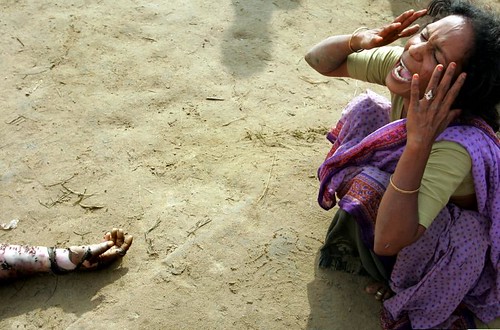



Ignacio Ellacuría, the Jesuit priest and rector of the UCA, may have been predicting his own slaying when he wrote that if the university were to make a clear, strong stand for justice, it would suffer persecution. And so it did. Yet his focus was not on what would happen to the privileged Jesuits at the university, but what was already happening to the majority of Salvadorans living in inhuman poverty.
Ellacuría once proposed an exercise of the imagination for this present age of atrocity; an exercise that calls people of good will to step outside their own comfort so that others might simply live:
I want you to set your eyes and your hearts on these people who are suffering so much-some from poverty and hunger, others from oppression and repression. Then, standing before this people thus crucified you must repeat St. Ignatius' examination from the first week of the [Spiritual] Exercises.
Ask yourselves: What have I done to crucify them? What do I do to uncrucify them? What must I do for this people to rise again?
Now, these many years later, Ellacuría's questions carry a new urgency for all of us mired in the global "war on terror." Indeed, we can look in many directions and see people suffering so much from the results of U.S. foreign and domestic policy. We need only turn our gaze toward Fallujah and Ramadi, the pulverized cities of Iraq, once cities of thousands, now shells, their populations scattered to makeshift desert dwellings and refugee camps. How did we contribute-by our taxes, our silence, our timidity-to their crucifixion?
- Chmiel and Wimmer, Uncrucify Them
Friday, November 18, 2005
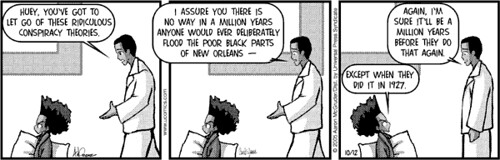
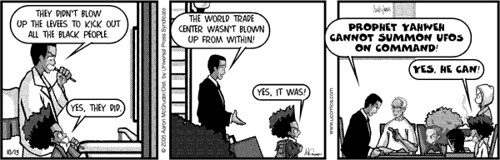
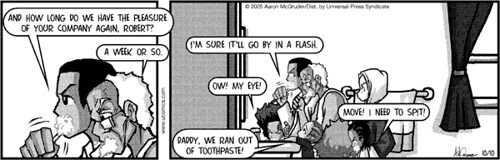
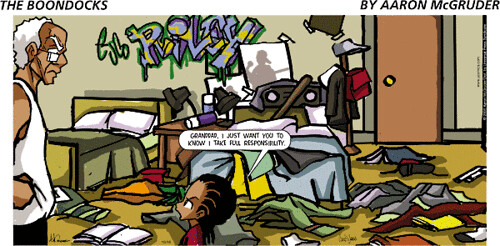
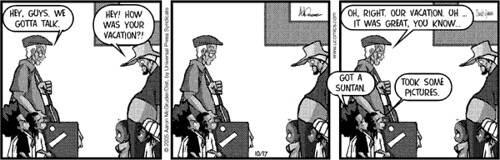
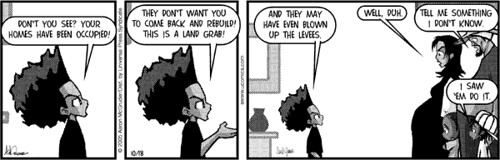
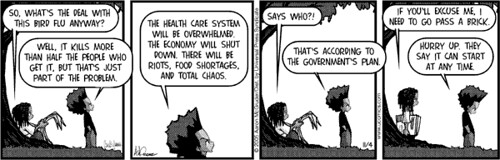

Thursday, November 17, 2005
Impacted And Aglitter

With a jackahmmer for the big chunks and a set of scalpels for the encrusted gems perhaps this dense, complex agglomeration of propaganda - ranging far and wide in the realm of ideological work from the bolstering of unthinking class contempt to orisons to American exceptionalism - could be dismantled, but it would be a shame to destroy a mechanism of such impressive intricacy:
We've never had an e-mail response like the one we got after Monday's segment with Stephen Jones, a professor in the department of physics and astronomy at Brigham Young University. Jones believes that the World Trade Center buildings were likely brought down by bombs, rather than by hijacked planes on 9-11. "Use of powerful, pre-positioned explosives in the WTC buildings would imply an 'inside job'," Jones writes in a paper available on the BYU website. "Clearly, we must find out what really caused the WTC skyscrapers to collapse as they did."
When one of my producers first told me about him, my first thought was: Stephen Jones is insane. And he may be. On the other hand, he does have a legitimate job and a responsible-sounding title. He's not living in the park, or writing me letters in crayon. How crazy could he really be? In the interest of open-mindedness, we booked him.
That was probably a mistake. Talking about 9-11 is a lot like discussing someone else's religion: You can do it, but you've got to tread carefully. Most of the time, it's best to stick to platitudes and move on. The subject is still too raw for debate, particularly here in the New York area. (The little town where I live lost six people on September 11th; the town next door lost more than 20.) Professor Jones wasn't up to the job. If you saw last night's show, you know what an uncomfortable six minutes it was. If not, I'll summarize: Jones was almost totally incapable of explaining his own ideas. By the end of the interview I understood no more about his hypothesis than when it began. He was an epically bad guest.
Yet - and here's the interesting part - he seemed to connect with a huge number of viewers. Some who e-mailed were offended that Jones would dare question the official version of 9-11. Some were confused by what he was trying to say. But the overwhelming majority wrote to thank me for my "courage" in putting him on, and to complain that we didn't give him more time to explain the conspiracy.
In other words, a lot of people seem to think it's possible that the U.S. government had a hand in bringing down the World Trade Center buildings.
Ponder that for a second: The U.S. government killed more than 3,000 of its own citizens. For no obvious reason. Then lied about it. Then invaded two other countries, killing thousands of their citizens as punishment for a crime they didn't commit.
If you really thought this - or even considered it a possibility - how could you continue to live here? You couldn't. You'd leave the United States on the next available flight and not come back. You'd have no choice. Continuing to pay taxes to a government capable of something so evil would make you complicit in the crime.
So of course most of the people who wrote to say they think the government might have been behind 9-11 don't really think the government might have been behind 9-11. For whatever reason, they just like to say so. Which as far as I'm concerned makes them phony and irresponsible.
Incidentally, we still have an open mind here on the Situation, even after Professor Stephen Jones. So if evidence ever does arise that the government lied substantially about what happened on September 11th, we'll be on it immediately. I promise.
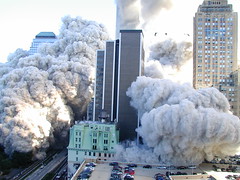
Subscribe to:
Posts (Atom)